
Master Arrays in Excel: Essential Techniques for Finance Pros
Master the use of array in Excel to enhance financial modeling and streamline your analysis.

Introduction
Mastering arrays in Excel is a crucial skill for finance professionals who seek to boost efficiency and accuracy in their data analysis. These robust structures empower users to execute complex calculations and streamline workflows, fundamentally changing how financial models are constructed and evaluated. Yet, the introduction of dynamic arrays presents both opportunities and challenges. How can finance experts effectively leverage these tools while ensuring clarity and auditability in their models?
By embracing the power of arrays, finance professionals can transform their analytical capabilities. Imagine the ability to handle vast datasets with ease, performing intricate calculations that were once time-consuming. This not only enhances productivity but also elevates the quality of insights derived from financial data.
Incorporating dynamic arrays into your workflow can lead to significant improvements in model accuracy and efficiency. As you navigate this evolving landscape, consider how these tools can simplify your processes while maintaining the integrity of your analyses. The journey to mastering arrays is not just about learning new functions; it's about redefining how you approach financial modeling.
Define Arrays in Excel: Core Concepts and Importance
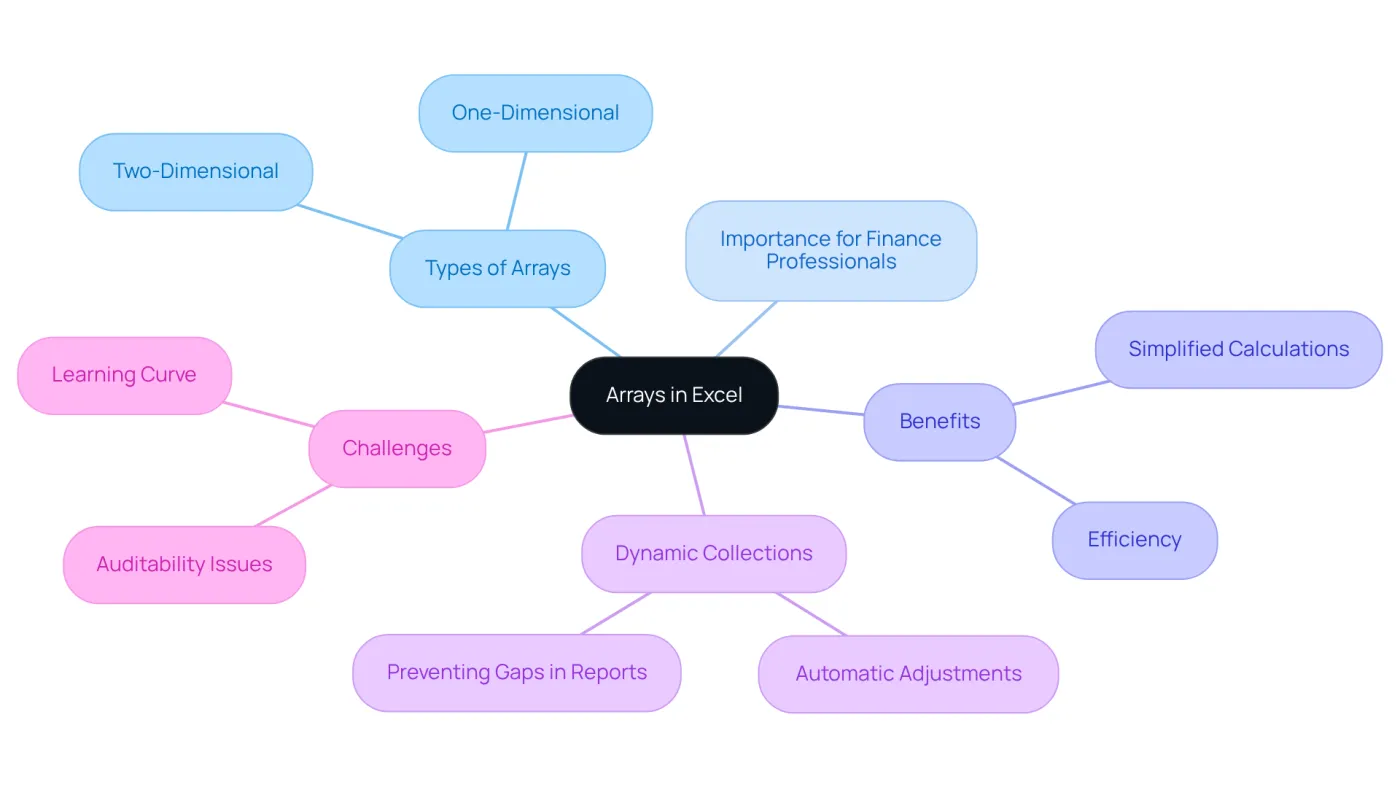
Handling an array in Excel as a single unit of values or a range of boxes is crucial for efficiency. Arrays can be one-dimensional, like a row or a column, or two-dimensional, resembling a table. For finance professionals, understanding data structures is essential. They enable complex calculations and data analysis without the need for numerous formulas. Imagine simplifying tasks like summing a range of values or performing calculations across multiple cells simultaneously. This efficiency is particularly beneficial in economic modeling, where accuracy and speed are paramount.
Dynamic collections represent a contemporary upgrade in Excel, enhancing financial modeling by allowing these structures to automatically adjust based on input changes. This adaptability helps prevent gaps in reports. Experts like Nicholas Hay emphasize that using charts and graphs can make data trends and discrepancies immediately apparent, facilitating quicker and more accurate analyses. However, finance professionals must also recognize the challenges posed by dynamic collections, such as potential issues with auditability and the necessity for a structured approach to ensure clarity in complex models.
By utilizing data structures, finance experts can reduce the complexity of their models, minimize potential error areas, and focus more on analysis rather than manual calculation creation. The adoption of an array in Excel not only streamlines workflows but also aligns with best practices in financial modeling, ensuring robust and trustworthy outputs.
Explore Array Formulas: Structure and Functionality
Array in Excel functions stand out because they can produce multiple outcomes or perform various calculations on a set of values. Unlike standard calculations, these functions are entered using the Ctrl + Shift + Enter key combination. For example, an array in Excel can sum a range of cells and display the result in one cell, or it can populate several cells with results from a single expression.
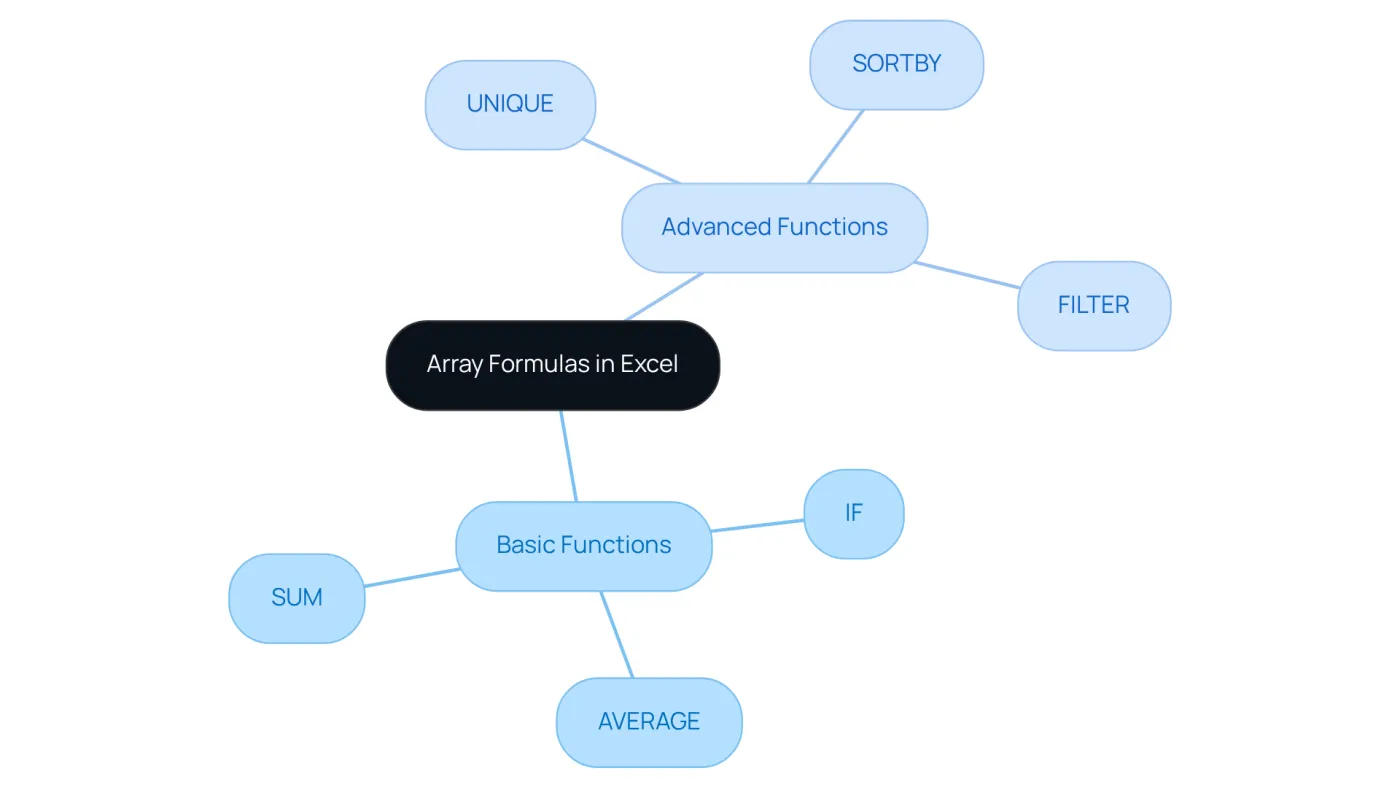
Understanding how to organize these equations is crucial for finance experts. They can significantly reduce the complexity of financial models and enhance data analysis skills. Common functions used in list calculations, such as:
- SUM
- AVERAGE
- IF
can be applied across an array in Excel and various data ranges.
Moreover, embracing dynamic structures can improve flexibility and accuracy in financial modeling. This enables automatic adjustments and minimizes errors. Functions like:
- UNIQUE
- SORTBY
- FILTER
showcase the evolving capabilities of Excel, allowing finance professionals to streamline their workflows and clarify their analyses using an array in Excel.
By leveraging these advanced features, finance professionals can not only simplify their models but also boost their overall productivity. Are you ready to transform your financial analysis with these powerful tools?
Implement Array Formulas: Step-by-Step Instructions
To implement an array formula in Excel, follow these essential steps:
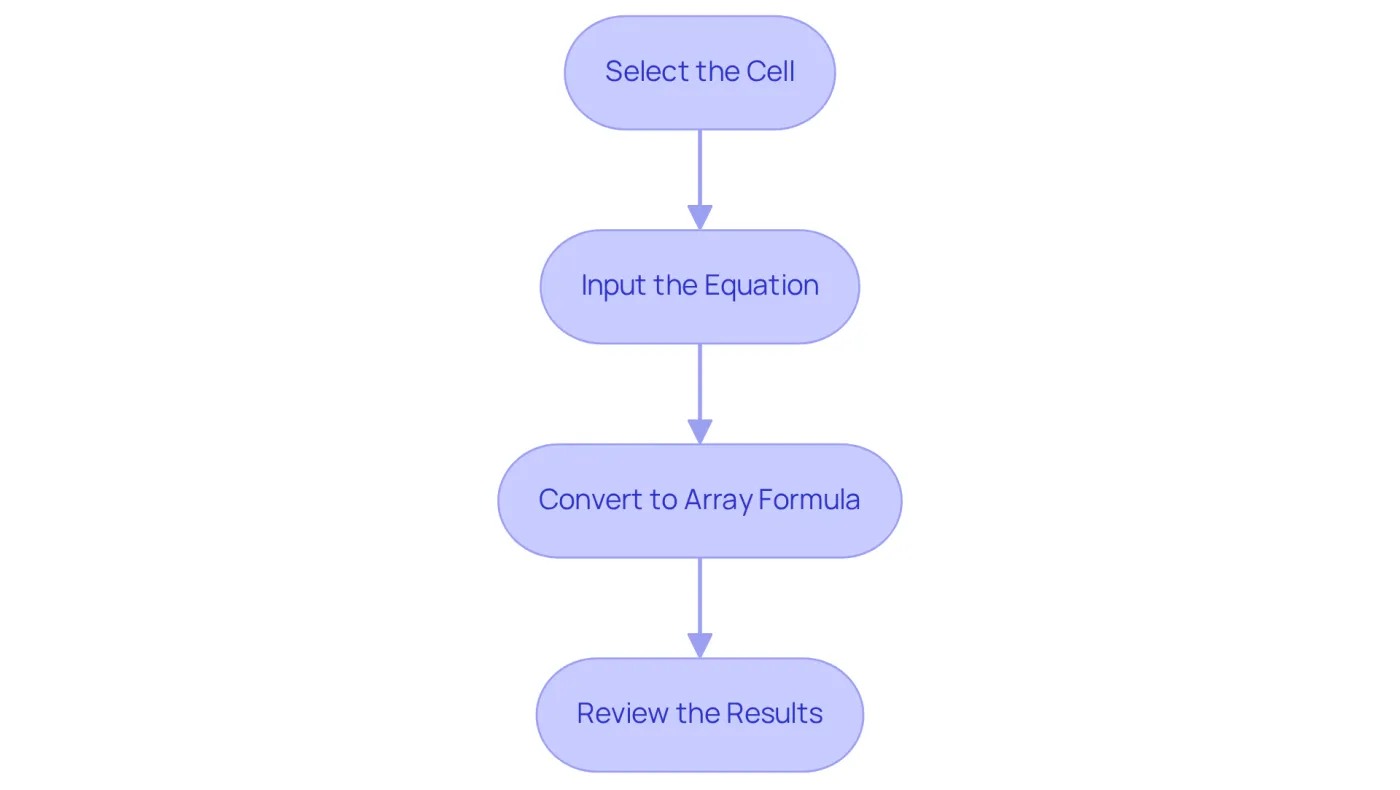
- Select the Cell: Click on the cell where you want the outcome of your calculation to appear.
- Input the Equation: Begin typing your equation using standard Excel syntax. For instance, to sum a range of values, you might type
=SUM(A1:A10). - Convert to Array Formula: Instead of pressing Enter, press Ctrl + Shift + Enter. Excel will automatically place curly braces
{}around your calculation, indicating it’s a collection of values. - Review the Results: The outcome will display in the selected cell. If your calculation is designed to yield multiple results, ensure you’ve selected enough cells to present them all.
Consider this: if you aim to compute the overall sales for various products, employing a structured approach to aggregate sales across different areas simultaneously can significantly enhance your analysis efficiency. By mastering the array in Excel formulas, you not only streamline your calculations but also enhance your data analysis capabilities.
Utilize Advanced Array Techniques: Examples and Applications
Enhance Your Financial Modeling with Advanced Data Techniques
Advanced data techniques can significantly elevate your financial modeling capabilities. Let’s explore a few powerful examples that can transform your approach:
-
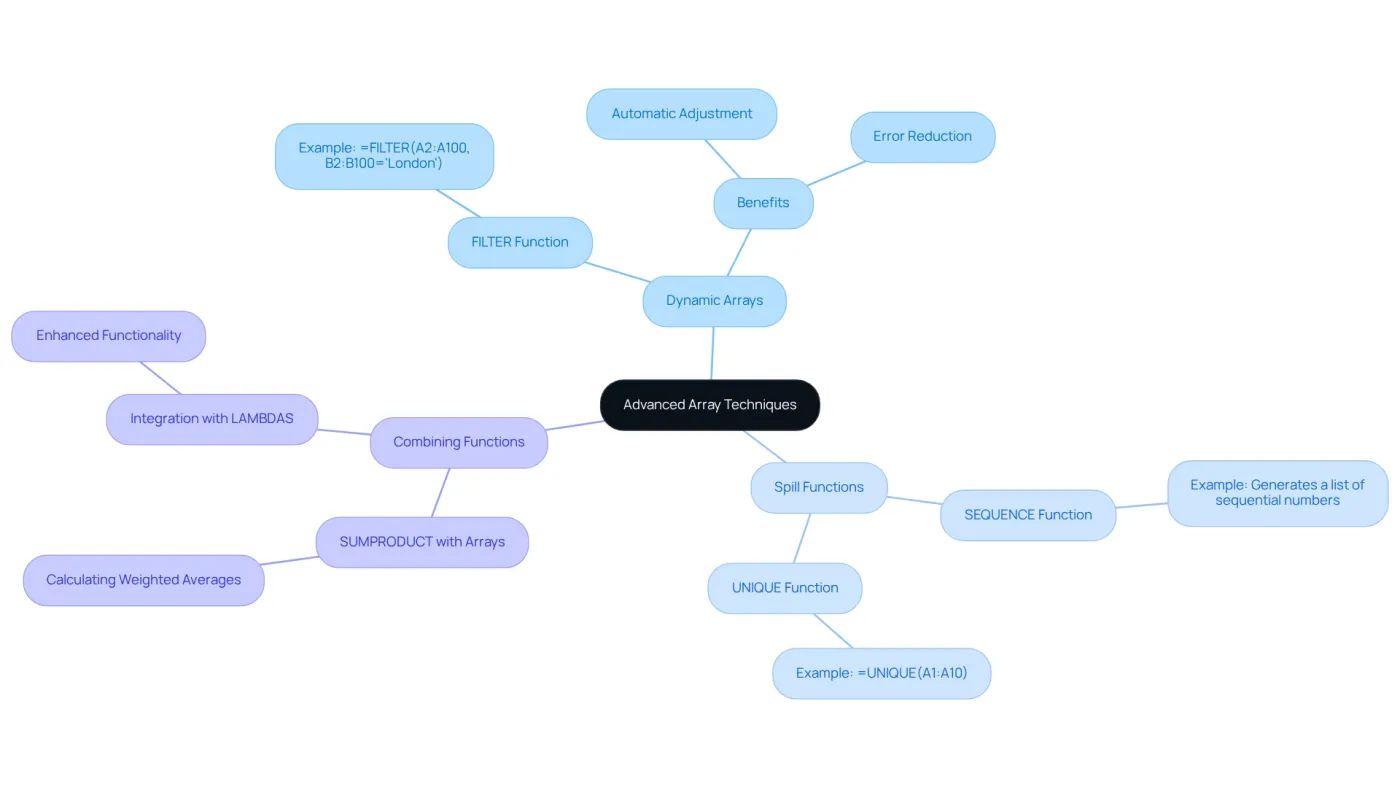
Dynamic Arrays: The introduction of dynamic arrays in Excel allows for formulas that automatically adjust to your data size. For instance, the
FILTERfunction enables you to extract specific data points based on criteria, eliminating the need for manual range adjustments. -
Spill Functions: Functions like
SEQUENCEandUNIQUEgenerate lists that automatically populate adjacent cells. For example,=UNIQUE(A1:A10)provides a list of unique values from the specified range, simplifying the analysis of distinct data points in your reports. -
Combining Functions: Merging multiple list functions can facilitate complex calculations. For instance, using
SUMPRODUCTwith an array in Excel helps to calculate weighted averages or other intricate metrics in financial models.
These advanced techniques not only streamline your workflow but also minimize the likelihood of errors. By integrating these tools into your financial modeling, you position yourself for greater accuracy and efficiency, making them invaluable assets for finance professionals.
Conclusion
Mastering arrays in Excel is not merely a technical skill; it represents a pivotal approach for finance professionals eager to elevate their analytical capabilities. By grasping and applying arrays, finance experts can streamline workflows, minimize errors, and concentrate on extracting insights instead of getting mired in intricate calculations. The ability to manipulate data as a unified entity fosters more efficient financial modeling and analysis.
This article has delved into essential concepts such as:
- The definition of arrays
- The structure and functionality of array formulas
- Advanced techniques
Dynamic arrays, spill functions, and the integration of multiple functions illustrate how these tools can simplify complex tasks and enhance accuracy in financial reports. The step-by-step instructions provided ensure that even those new to this feature can confidently implement it in their work.
Ultimately, the importance of mastering arrays in Excel transcends mere efficiency; it empowers finance professionals to make informed decisions grounded in accurate data analysis. Embracing these techniques not only boosts individual productivity but also fortifies the overall integrity of financial modeling. Now is the time to harness the power of arrays and transform financial analysis into a more streamlined and insightful process.
Frequently Asked Questions
What is an array in Excel?
An array in Excel is defined as a single unit of values or a range of boxes, which can be either one-dimensional (like a row or a column) or two-dimensional (like a table).
Why are arrays important for finance professionals?
Arrays are important for finance professionals because they enable complex calculations and data analysis without requiring numerous formulas, thus improving efficiency and accuracy in tasks like summing values or performing calculations across multiple cells simultaneously.
How do dynamic collections enhance financial modeling in Excel?
Dynamic collections enhance financial modeling by automatically adjusting based on input changes, which helps prevent gaps in reports and improves the adaptability of data structures.
What challenges do dynamic collections present for finance professionals?
Dynamic collections can pose challenges such as potential issues with auditability and the need for a structured approach to ensure clarity in complex models.
How can using data structures in Excel benefit financial analysis?
Utilizing data structures can reduce the complexity of financial models, minimize potential error areas, and allow finance experts to focus more on analysis rather than manual calculation creation.
What best practices are associated with adopting arrays in Excel?
Adopting arrays in Excel aligns with best practices in financial modeling by streamlining workflows and ensuring robust and trustworthy outputs.