
Master Google Spreadsheet Number Formats for Finance Professionals
Master Google Spreadsheet number formats to enhance financial data clarity and reporting efficiency.

Introduction
Mastering number formatting in Google Sheets is essential for finance professionals navigating the complexities of data management. The variety of numerical styles available can significantly enhance clarity and comprehension in financial reporting. But how can finance experts leverage these formatting techniques to present data more effectively? By doing so, they can improve decision-making and reduce errors, ultimately leading to more accurate financial outcomes.
Understand Google Sheets Number Formats
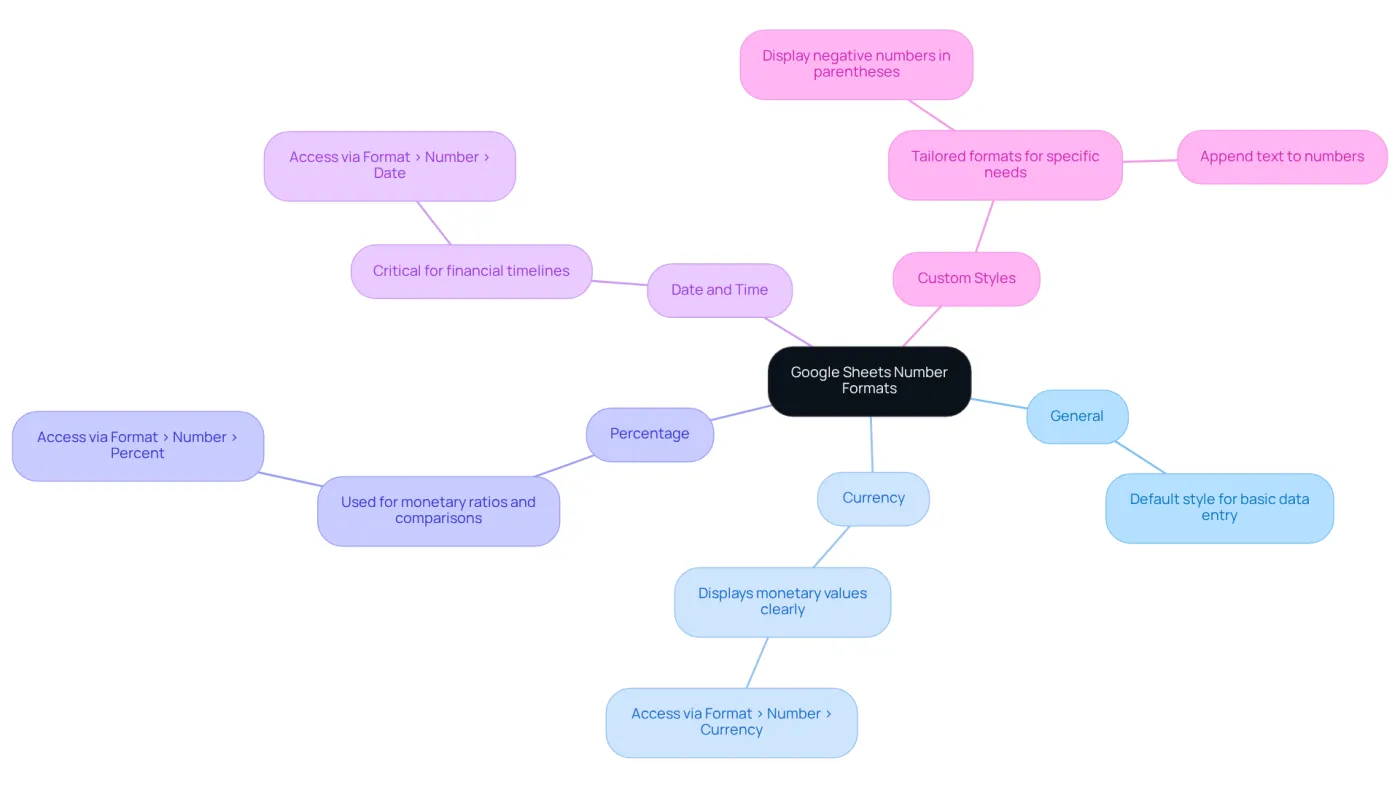
Google Sheets provides a variety of numerical styles in the google spreadsheet format number that are essential for finance professionals to effectively manage and present their data. Understanding the google spreadsheet format number is essential for enhancing clarity and comprehension in financial reporting. Here are the key styles:
- General: This default style displays numbers as entered, making it suitable for basic data entry tasks.
- Currency: A vital format for economic analysis, this structure allows users to present monetary values clearly. To apply the google spreadsheet format number, simply select the relevant cells and go to
Format > Number > Currency. - Percentage: This format is indispensable for monetary ratios and comparisons, displaying numbers as percentages. Access it via
Format > Number > Percentto use the google spreadsheet format number, which facilitates the visualization of data relationships. - Date and Time: Accurate date and time formatting is critical for financial timelines and reporting. Users can format dates by selecting
Format > Number > Datein the google spreadsheet format number, ensuring clarity in financial documentation. - Custom Styles: Users can create tailored formats to meet specific reporting needs, such as displaying negative numbers in parentheses or appending text to numbers (e.g., converting "$1,000" to "1,000 USD"). This flexibility enhances information presentation and ensures consistency across documents in google spreadsheet format number.
Finance professionals increasingly rely on these structures, with a significant number utilizing the google spreadsheet format number for their data management needs. Recent statistics indicate that a large portion of finance experts report using Google Sheets, underscoring its relevance in the industry. Effective use of numerical representations not only boosts readability but also enhances comprehension, enabling analysts to convey insights more clearly. For instance, a case study demonstrated how customized formats can categorize economic information, improving visual understanding and decision-making.
As we look ahead to 2026, the demand for information literacy will only grow. Mastering these numerical styles will be essential for finance professionals aiming to leverage data effectively in their roles.
Apply Effective Number Formats for Financial Data
To effectively apply number formats for financial data, consider these essential practices:
-
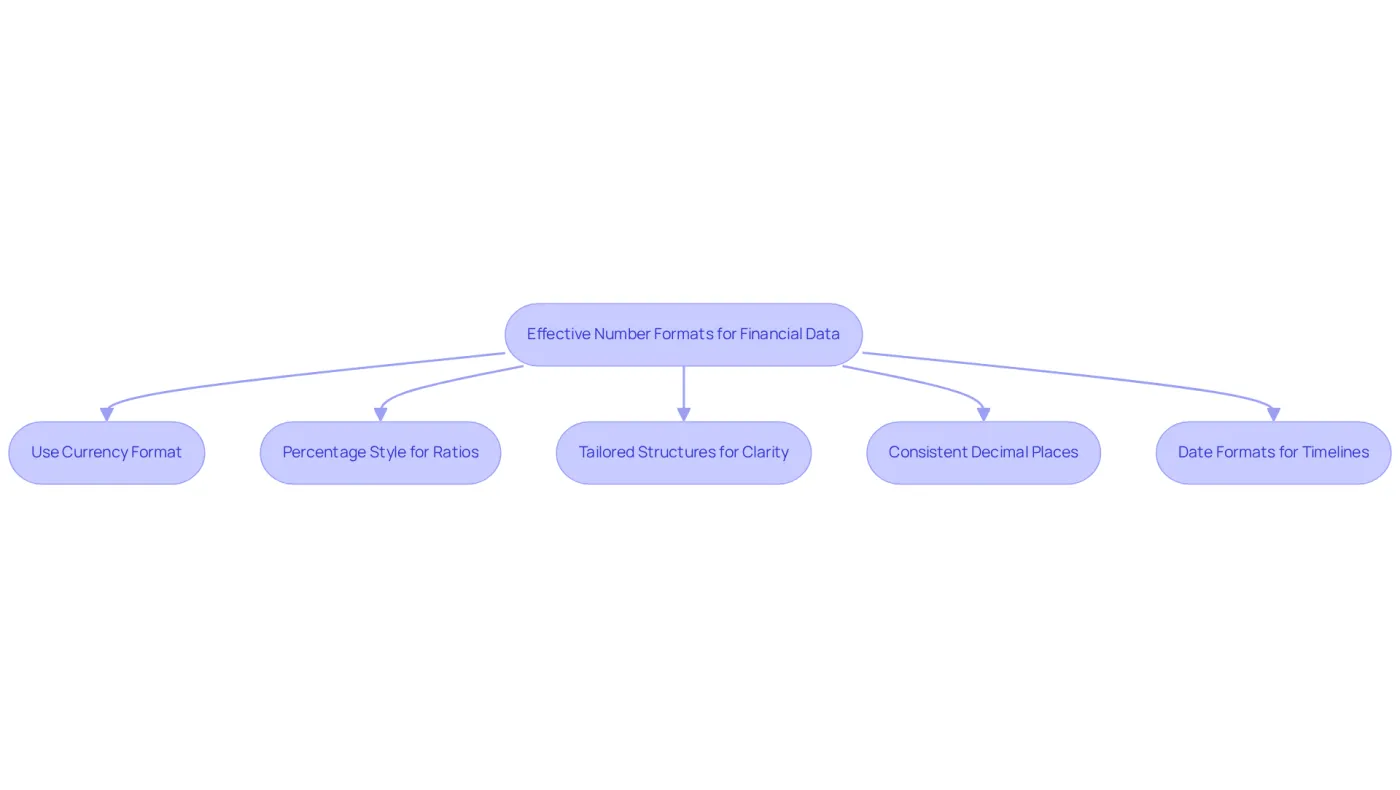
Use Currency Format for Financial Figures: Always format monetary values using the currency format to ensure clarity. This can be accomplished by selecting the cells and using the google spreadsheet format number option, then choosing
Format > Number > Currency. Proper currency formatting is crucial; studies indicate that clear documentation significantly improves understanding and reduces mistakes in reporting. For instance, research by the Financial Accounting Standards Board found that well-structured monetary statements can decrease misinterpretation by up to 30%. -
Percentage Style for Ratios: When managing economic ratios, such as profit margins or growth rates, utilize the percentage style. This approach aids in quick visual assessments of performance, enabling finance professionals to make informed decisions swiftly. As finance expert Warren Buffett states, "Understanding the numbers is key to making sound investment decisions."
-
Tailored Structures for Clarity: For financial statements, consider using tailored structures to enhance readability. For example, display negative numbers in red or with parentheses to distinguish them easily. This can be set up using the google spreadsheet format number option by going to
Format > Number > More Formats > Custom Number Format. Such visual signals are vital for prompt recognition of crucial information points. A case study from a prominent investment company demonstrated that utilizing color-coded formats improved clarity and reduced reporting mistakes by 25%. -
Consistent Decimal Places: Maintain a consistent number of decimal places across similar data types. For instance, if presenting monetary figures, decide whether to display two decimal places for all currency values. Consistency in formatting not only enhances clarity but also reflects professionalism in financial reporting. Common pitfalls include using differing decimal places, which can confuse stakeholders and lead to misinterpretation of information.
-
Date Formats for Timelines: Use appropriate date formats for monetary timelines. For example, employ
MM/DD/YYYYfor clarity in reporting periods. Correct date formatting is essential for monitoring economic performance over time, ensuring that stakeholders can easily grasp the information.
By applying these formatting techniques, finance professionals can present their information in a clear, professional manner that enhances comprehension and supports effective decision-making.
Utilize Advanced Formatting Techniques for Clarity
To enhance clarity in financial spreadsheets, consider implementing advanced formatting techniques that utilize the Google spreadsheet format number, which can significantly improve your data presentation and decision-making process.
-
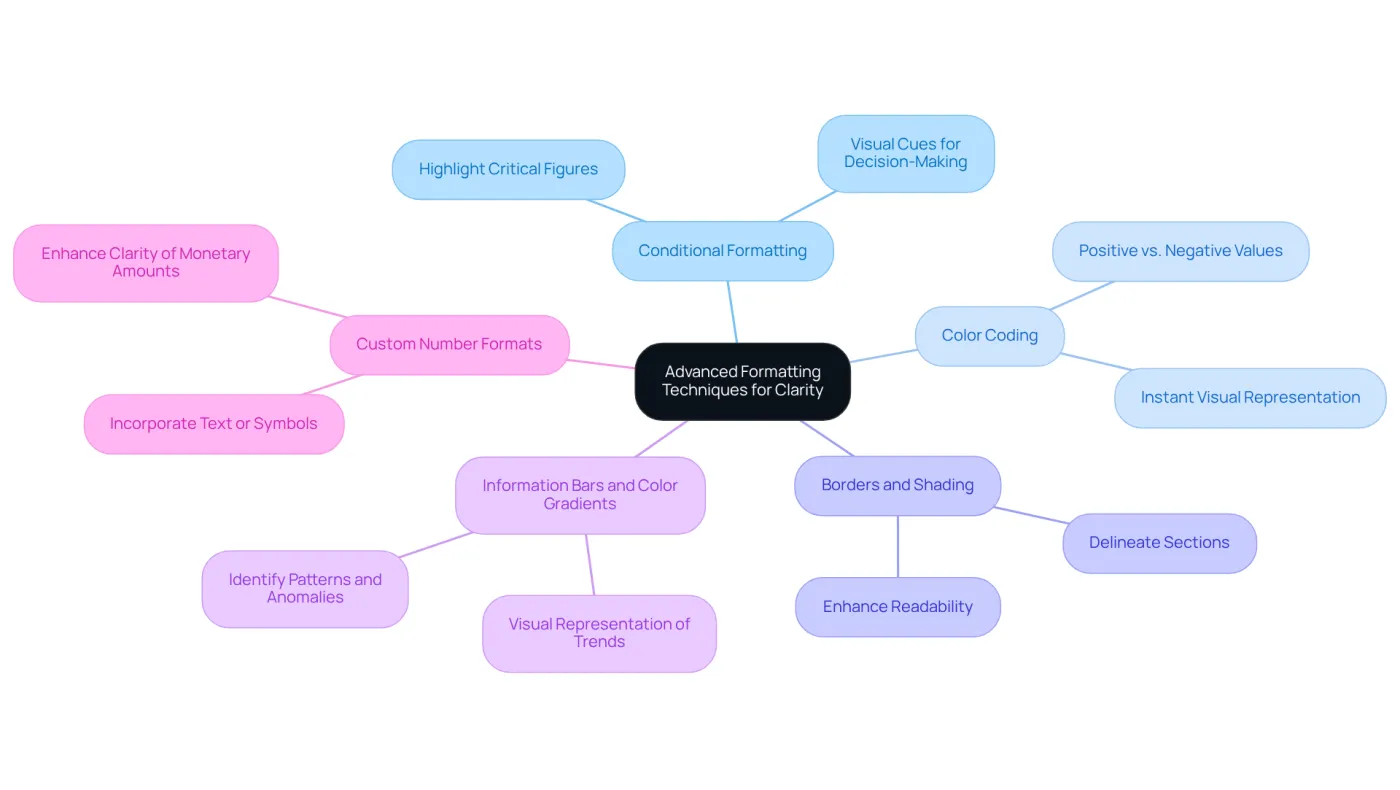
Conditional Formatting: Leverage conditional formatting to highlight critical figures, such as profit margins falling below a specified threshold or expenses that exceed budgeted amounts. Access this feature via
Format > Conditional formattingfor immediate visual cues that facilitate quick decision-making. -
Color Coding: Use color coding to differentiate between various information types. For instance, employing green for positive values and red for negative values provides an instant visual representation of financial health, making it easier to assess performance at a glance.
-
Borders and Shading: Utilize borders and shading to delineate different sections of your spreadsheet. This organizational technique not only enhances visual appeal but also assists in navigating information. For example, a light gray background for header rows can effectively distinguish them from entries, improving readability.
-
Information Bars and Color Gradients: Implement information bars or color gradients to visually represent trends. These tools are particularly advantageous for comparing economic performance over time, allowing users to swiftly identify patterns and anomalies in their data.
-
You can create custom number formats in Google spreadsheet format number that incorporate text or symbols for added context. For instance, formatting a cell to show '1,000 USD' rather than just '1000' enhances clarity and ensures that monetary amounts are easily comprehended.
By employing these advanced techniques, finance professionals can create spreadsheets that are not only functional but also visually engaging, thereby enhancing the communication of insights. Research indicates that effective use of conditional formatting can significantly enhance analysis outcomes, with only 20% of analytics insights anticipated to deliver business results without such improvements. This underscores the importance of adopting these practices to maximize the impact of monetary information. Furthermore, as Piyanka Jain highlights, "Everybody requires information literacy, because information is ubiquitous. It’s the new currency, it's the language of the business." Regularly reviewing spreadsheets for errors and outdated information is crucial for maintaining data accuracy and ensuring effective financial management.
Leverage Tools to Enhance Spreadsheet Efficiency
Enhance Your Efficiency in Google Sheets
Finance professionals often face challenges in managing data effectively. Fortunately, several tools and add-ons can significantly streamline your workflow when using Google spreadsheet format number.
-
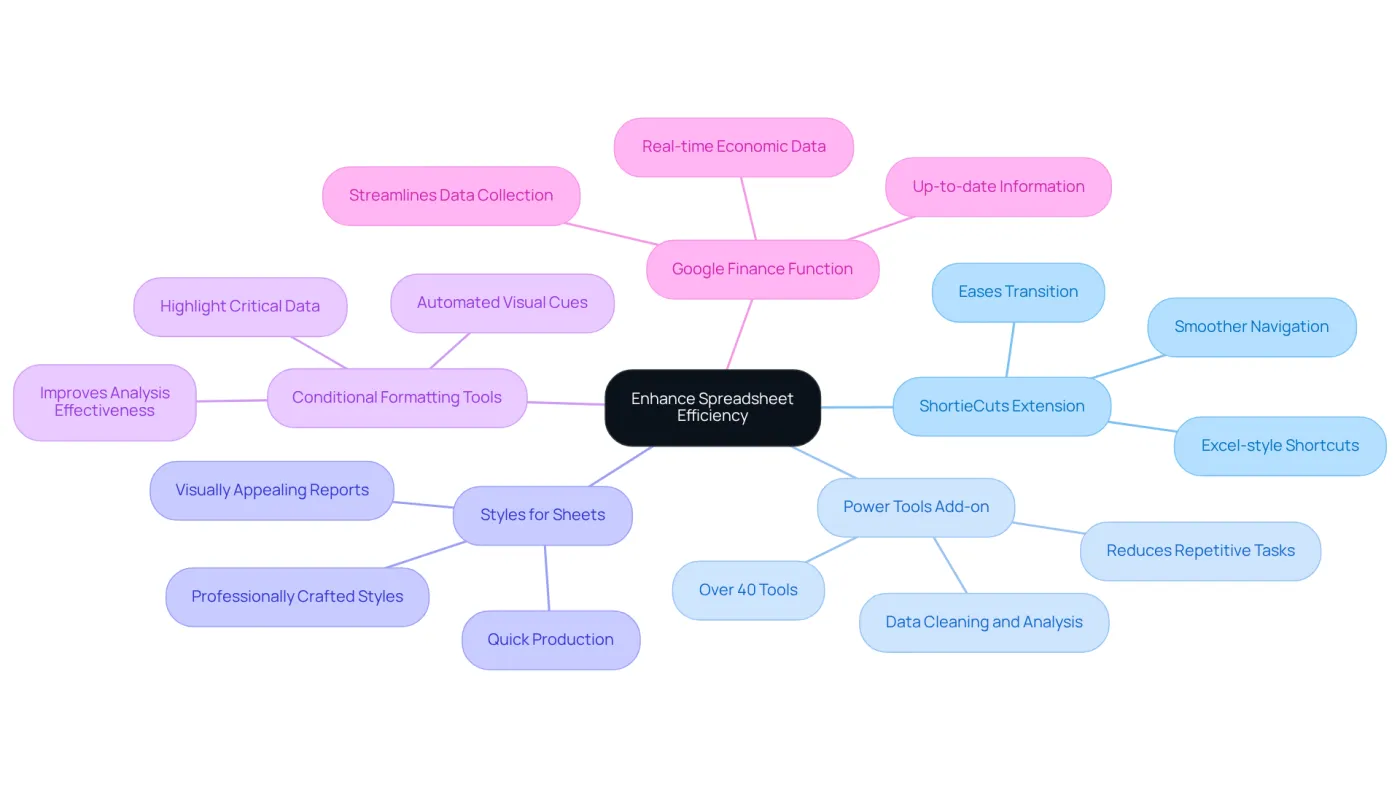
ShortieCuts Extension: This Chrome extension brings Excel-style shortcuts to Google Sheets, allowing for smoother navigation and formatting. By replicating familiar Excel functionalities, it eases the transition for finance professionals, making your work more efficient.
-
Power Tools Add-on: With over 40 tools designed for cleaning, analyzing, and transforming data, this add-on simplifies management tasks. It can drastically cut down the time spent on repetitive activities, allowing you to focus on more critical analyses.
-
Styles for Sheets: This tool provides a collection of professionally crafted styles tailored for budgeting. It helps you produce visually appealing reports quickly, enhancing the presentation of your financial data.
-
Conditional Formatting Tools: Leverage built-in conditional formatting options to automate visual cues for essential information. Highlighting cells that meet specific criteria ensures that critical data stands out, making your analysis more effective.
-
Google Finance Function: Utilize the
GOOGLEFINANCEfunction to pull real-time economic data directly into your spreadsheets. This feature streamlines data collection and analysis, providing you with up-to-date information at your fingertips.
By integrating these tools into your workflow, you can boost productivity, minimize manual errors, and create more impactful financial analyses in Google spreadsheet format number. Don't miss out on the opportunity to enhance your efficiency-start using these tools today!
Conclusion
Mastering number formats in Google Sheets is essential for finance professionals who aim to present their data with clarity and effectiveness. Understanding and applying various numerical styles not only enhances reporting but also strengthens decision-making processes, ensuring that critical financial information is communicated with precision.
This article outlines several key formatting styles, such as:
- Currency
- Percentage
- Date
- Custom formats
Each serving a distinct purpose in financial reporting. Techniques like conditional formatting and color coding further enhance data visibility, while utilizing tools and add-ons streamlines workflow and boosts productivity. By adopting these best practices, finance professionals can significantly minimize errors and elevate the overall quality of their financial documents.
In an era where information literacy is paramount, mastering Google Sheets number formats transcends mere technical skill; it becomes a strategic advantage. Embracing these formatting techniques fosters better insights and informed decision-making, ultimately propelling success in financial management. It is crucial for finance professionals to continually refine their skills and leverage these tools to maintain a competitive edge in an ever-evolving landscape.
Frequently Asked Questions
What are the main number formats available in Google Sheets?
The main number formats in Google Sheets include General, Currency, Percentage, Date and Time, and Custom Styles.
How does the General format work in Google Sheets?
The General format displays numbers as they are entered, making it suitable for basic data entry tasks.
What is the purpose of the Currency format in Google Sheets?
The Currency format is essential for economic analysis as it allows users to present monetary values clearly.
How can I apply the Currency format to cells in Google Sheets?
To apply the Currency format, select the relevant cells and navigate to Format > Number > Currency.
When should I use the Percentage format in Google Sheets?
The Percentage format is important for displaying monetary ratios and comparisons, helping to visualize data relationships.
How do I access the Percentage format in Google Sheets?
You can access the Percentage format by selecting Format > Number > Percent.
Why is accurate Date and Time formatting important in Google Sheets?
Accurate Date and Time formatting is critical for financial timelines and reporting, ensuring clarity in financial documentation.
How can I format dates in Google Sheets?
To format dates, select Format > Number > Date.
What are Custom Styles in Google Sheets?
Custom Styles allow users to create tailored formats to meet specific reporting needs, such as displaying negative numbers in parentheses or appending text to numbers.
How do customized formats improve data presentation in Google Sheets?
Customized formats enhance information presentation and ensure consistency across documents, improving visual understanding and decision-making.
Why is mastering these numerical styles important for finance professionals?
Mastering these numerical styles is essential for finance professionals to effectively leverage data, enhance readability, and improve comprehension in their roles.