
Master Merging Excel Cells: A Step-by-Step Guide for Finance Pros
Learn to merge Excel cells effectively for better spreadsheet organization and clarity.

Introduction
Merging cells in Excel transcends mere formatting; it serves as a powerful tool that significantly enhances the clarity and professionalism of financial reports. For finance professionals, mastering this skill is essential. It leads to more organized spreadsheets and fosters improved communication with stakeholders. However, merging cells presents its own challenges - excessive merging can complicate data management and hinder functionality.
So, how can finance experts effectively leverage this technique while steering clear of common pitfalls?
Understand the Importance of Merging Cells in Excel
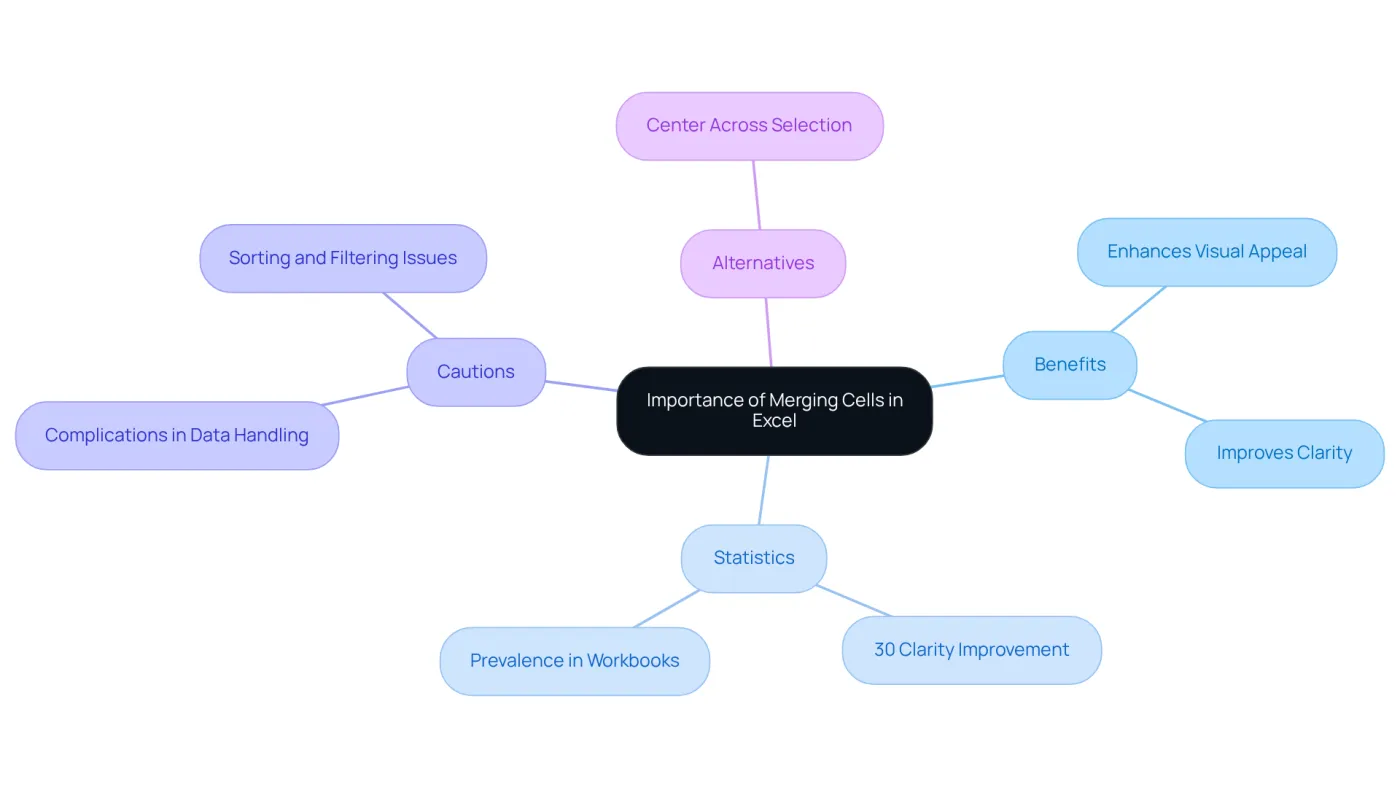
To merge Excel cells is an essential skill that significantly enhances the visual appeal and organization of spreadsheets, especially for finance professionals. This technique allows for a clearer presentation of information, particularly when you need to merge Excel cells for designing headers or titles that span multiple columns. To create a cohesive narrative that simplifies interpretation for stakeholders reviewing financial reports, it is essential to merge Excel cells in the header to unify various information points.
Did you know that studies suggest efficient use of combined sections can enhance clarity by as much as 30%? This improvement facilitates easier navigation through intricate information sets. Moreover, Microsoft telemetry indicates that over half of all Excel workbooks include instances that merge Excel cells, highlighting the prevalence of this practice in the industry.
However, it’s crucial to apply this feature judiciously. Excessive merging can complicate information handling and examination. Formulas referencing merged sections often default to the top-left section's value, which can lead to mistakes. Additionally, merged entries can obstruct sorting and filtering functions, essential for effective information management. Experts recommend using integration to merge Excel cells primarily for visual clarity in presentations rather than for functional data management.
Consider an alternative approach: 'Center Across Selection.' This method can achieve a similar visual effect without the complications associated with merging elements. By understanding when and how to combine sections effectively, finance professionals can significantly enhance the clarity and professionalism of their spreadsheets. This ultimately improves communication and decision-making within their organizations.
Follow Step-by-Step Instructions to Merge Cells
To merge cells in Excel effectively, follow these steps:
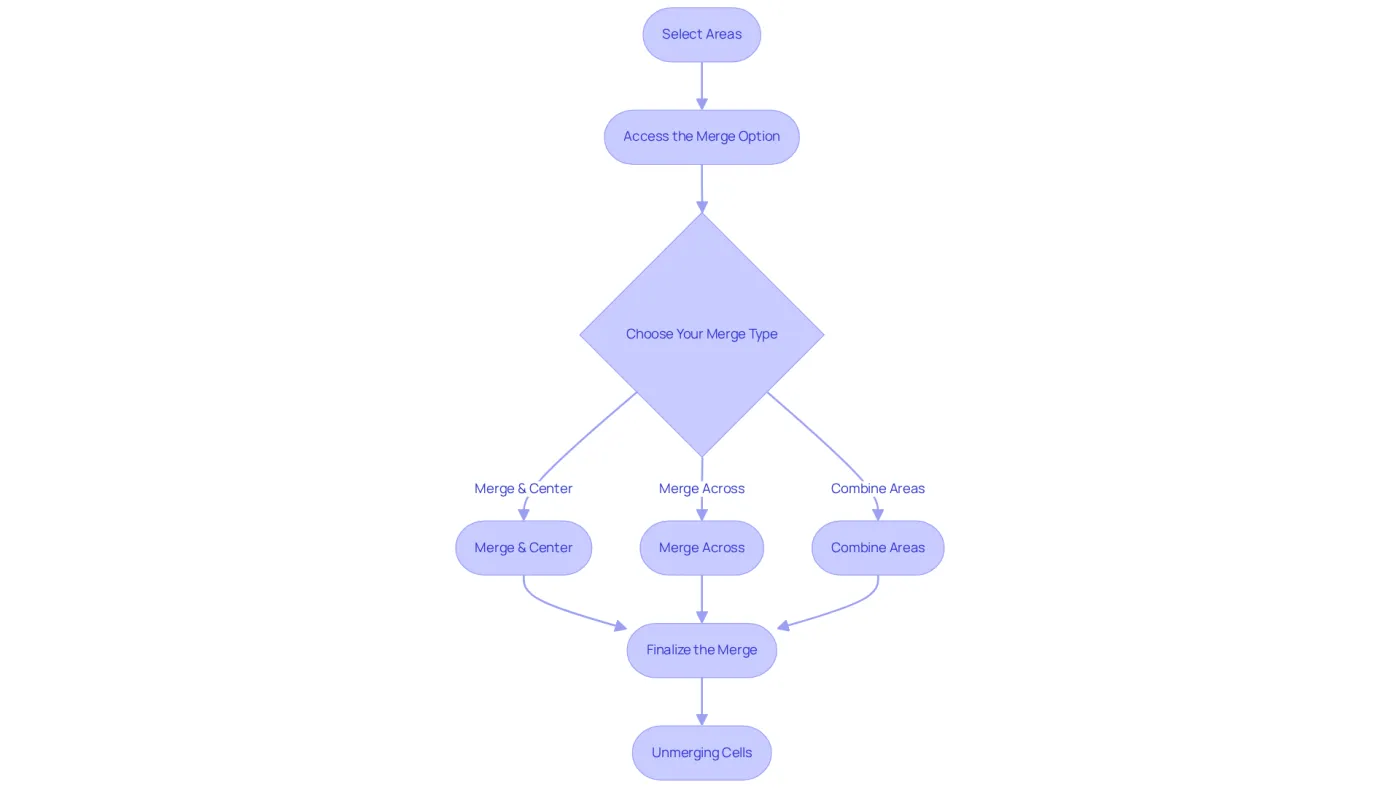
- Select the Areas: Highlight the areas you wish to merge, ensuring that the data you want to retain is in the upper-left section of your selection.
- Access the Merge Option: Navigate to the 'Home' tab on the Ribbon. In the 'Alignment' group, locate the 'Merge & Center' button.
- Choose Your Merge Type: Click the dropdown arrow next to 'Merge & Center' to explore the options:
- Merge & Center: Combines the selected cells into one and centers the content.
- Merge Across: Combines units in each row separately, beneficial for headers spanning multiple columns.
- Combine Areas: Merges the selected areas without centering the content, ideal for maintaining alignment with neighboring data.
- Finalize the Merge: Select your preferred option. The units will combine into one larger unit, improving the visual arrangement of your spreadsheet.
- Unmerging Cells: If you need to reverse the merge, select the merged area, return to the 'Merge & Center' dropdown, and choose 'Unmerge Areas'. This enables you to allocate the text back into distinct sections, enhancing information organization.
Utilizing these steps not only streamlines your spreadsheet layout but also demonstrates best practices observed in financial spreadsheets, particularly when you need to merge excel cells for clarity and organization. For instance, case studies have demonstrated that efficient combination of elements can greatly improve the clarity of financial reports, allowing key information to stand out. Keep in mind, when combining areas, only the content in the upper-left section will stay, so always verify your information before moving forward.
Troubleshoot Common Issues When Merging Cells
When merging cells in Excel, several common issues can disrupt your workflow:
-
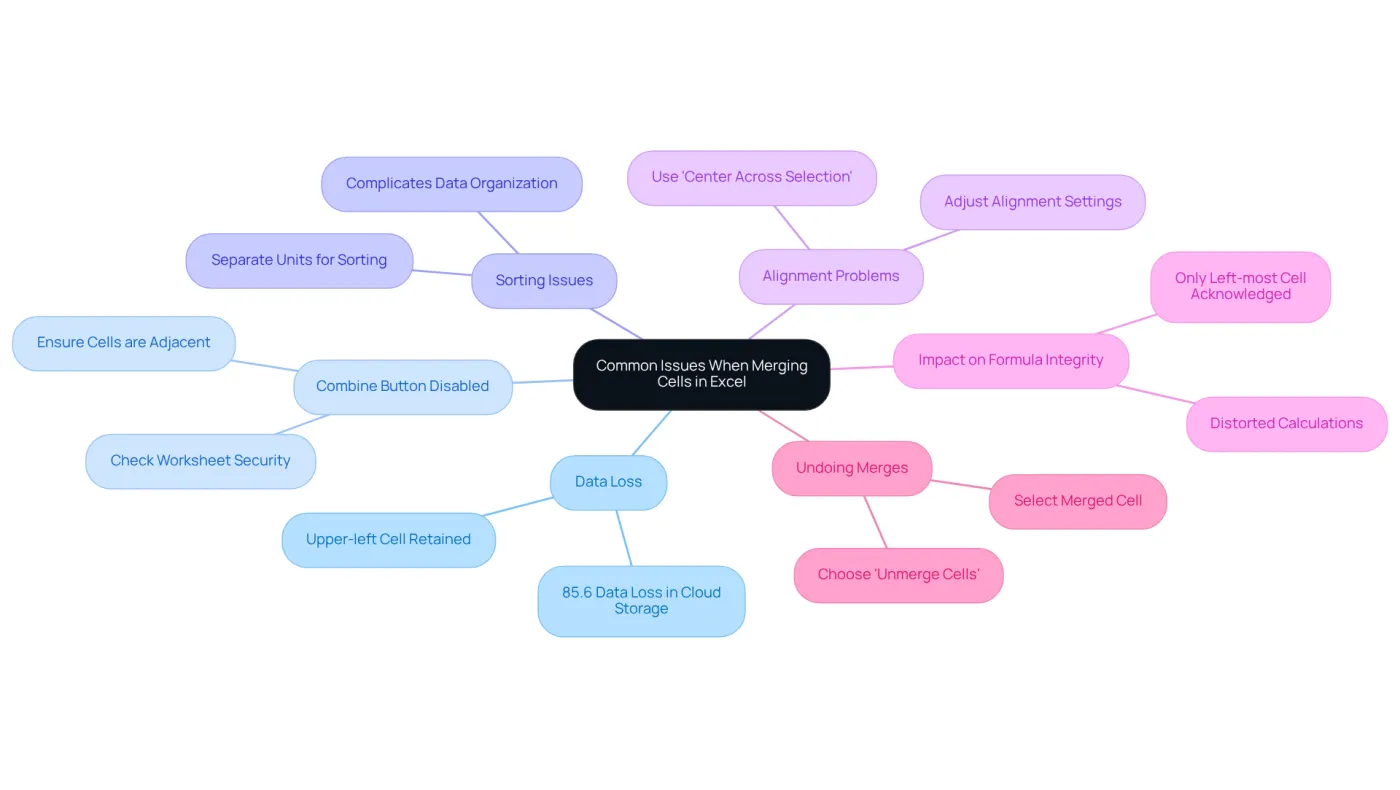
Data Loss: Only the content of the upper-left square is retained after merging. To prevent losing essential information, ensure that any crucial details are placed in this section before proceeding. Notably, 85.6% of data loss incidents occur in cloud storage, underscoring the importance of careful data management during this process.
-
Combine Button Disabled: If the merge option is inaccessible, check whether the worksheet is secured or if the areas you are attempting to join are not adjacent. This is often the reason for the disabled merge function.
-
Sorting Issues: Merged sections can complicate sorting and filtering operations. Experts indicate that combining units can obstruct data precision and effectiveness. If you need to organize your data, it’s advisable to separate the units first to maintain the integrity of your data structure.
-
Alignment Problems: After merging, text alignment may not appear as intended. Adjust the alignment settings in the 'Alignment' group to center or left-align the text according to your needs. Alternatively, consider using the 'Center Across Selection' feature, which can provide a similar appearance to merged areas without the associated issues.
-
Impact on Formula Integrity: Merging areas can lead to unexpected outcomes in calculations, as Excel only acknowledges the left-most area in a merged range. This can distort your information representation, so it’s essential to keep unmerged units and not merge excel cells for accurate calculations.
-
Undoing Merges: If you accidentally merge cells, you can easily reverse this action by selecting the merged cell and choosing 'Unmerge Cells' from the dropdown menu.
Being aware of these potential issues allows you to navigate the merging process more effectively, ensuring that your data remains organized and accessible.
Leverage ShortieCuts for Enhanced Merging in Google Sheets
Transform Your Google Sheets Experience with ShortieCuts
Merging cells in Google Sheets can often be a cumbersome task. However, with ShortieCuts, you can significantly enhance this experience by integrating Excel-style shortcuts and advanced functionalities. Here’s how to effectively utilize ShortieCuts for merging cells:
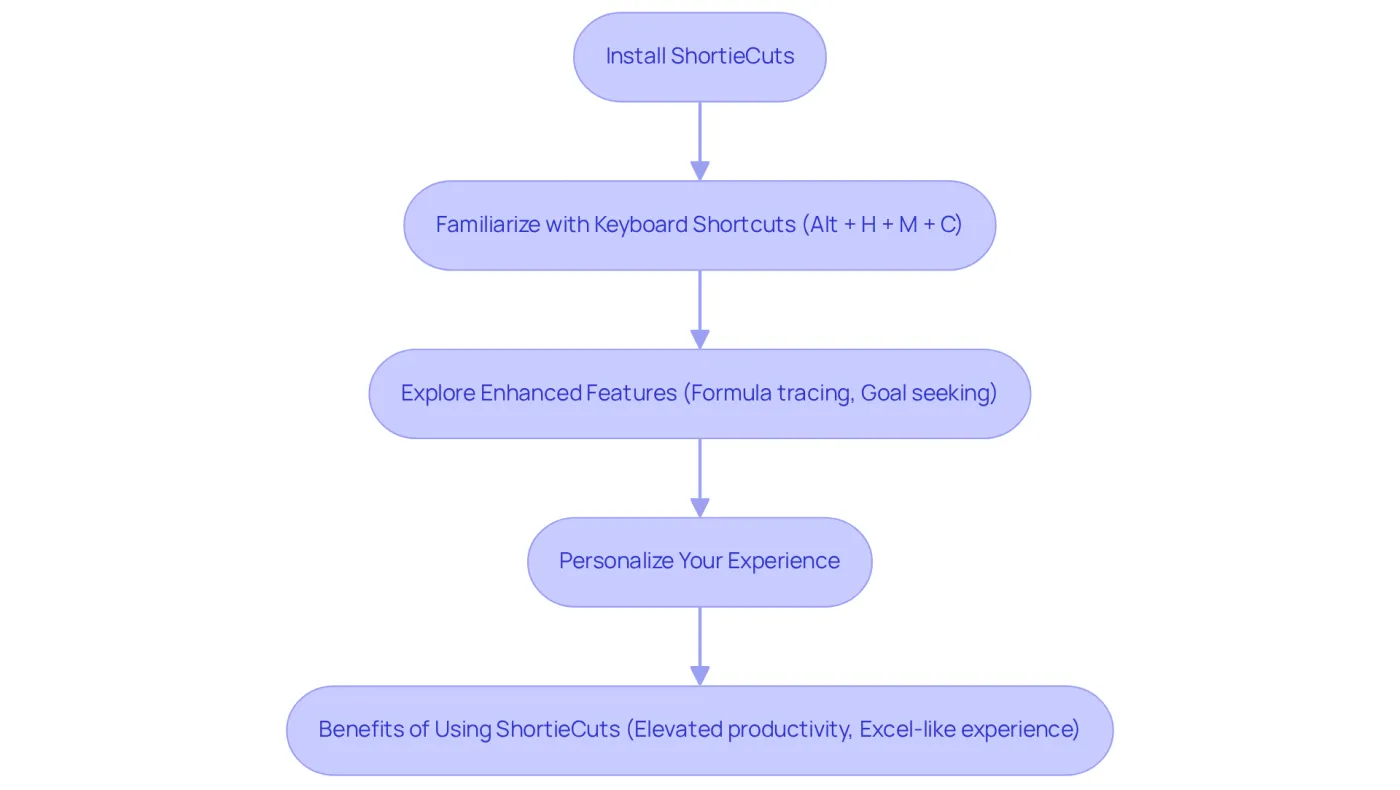
- Install ShortieCuts: Start by ensuring that the ShortieCuts extension is installed and activated in your Chrome browser.
- Employ Keyboard Shortcuts: Familiarize yourself with the keyboard shortcuts provided by ShortieCuts for combining cells. For instance, the shortcut
Alt + H + M + Callows you to quickly merge excel cells and center entries, optimizing your workflow. - Explore Enhanced Features: Leverage additional capabilities such as formula tracing and goal seeking, which complement your integration tasks and boost overall spreadsheet efficiency.
- Personalize Your Experience: Tailor the configurations in ShortieCuts to suit your unique workflow, ensuring that merging sections becomes a seamless part of your spreadsheet organization.
By harnessing the power of ShortieCuts, you can elevate your productivity and replicate the familiar Excel experience within Google Sheets. This transformation makes it a straightforward and efficient task to merge excel cells. With 233 Excel-style shortcuts at your disposal, finance professionals can navigate and manage their spreadsheets effortlessly, ultimately enhancing their operational efficiency.
Conclusion
Merging cells in Excel is an essential skill that significantly enhances the organization and visual appeal of spreadsheets, especially for finance professionals. This technique not only clarifies information presentation but also promotes better communication and decision-making. By mastering the appropriate contexts for merging cells, finance experts can craft more cohesive and accessible reports that resonate with stakeholders.
Throughout this article, we’ve underscored the importance of merging cells, providing practical step-by-step instructions for executing this task effectively. Key insights include the necessity for caution to avoid common pitfalls such as:
- data loss
- sorting issues
- the impact on formulas
Moreover, alternatives like the 'Center Across Selection' method offer a way to achieve similar visual effects without the complications of merging. The integration of tools like ShortieCuts in Google Sheets further enhances the merging experience, making it more efficient and user-friendly.
Ultimately, mastering the art of merging cells not only improves the clarity of financial reports but also empowers finance professionals to present their data more impactfully. Embracing these best practices can lead to increased productivity and a more professional appearance in reports. For anyone looking to excel in their financial documentation, adopting these strategies is not just beneficial; it’s essential.
Frequently Asked Questions
Why is merging cells in Excel important?
Merging cells in Excel enhances the visual appeal and organization of spreadsheets, making it particularly useful for finance professionals to create clearer presentations of information, especially in headers or titles.
How does merging cells improve clarity in spreadsheets?
Studies suggest that efficient use of merged sections can enhance clarity by as much as 30%, facilitating easier navigation through complex information sets.
How common is the practice of merging cells in Excel workbooks?
Microsoft telemetry indicates that over half of all Excel workbooks include instances of merged cells, highlighting its prevalence in the industry.
What are the potential downsides of excessive merging of cells?
Excessive merging can complicate information handling, cause formulas to default to the top-left cell’s value, and obstruct sorting and filtering functions, which are essential for effective data management.
What do experts recommend regarding the use of merged cells?
Experts recommend using merged cells primarily for visual clarity in presentations rather than for functional data management.
What is an alternative to merging cells that can achieve a similar visual effect?
The 'Center Across Selection' method can achieve a similar visual effect without the complications associated with merging cells.
How can finance professionals enhance the clarity of their spreadsheets?
By understanding when and how to merge cells effectively, finance professionals can improve the clarity and professionalism of their spreadsheets, which enhances communication and decision-making within their organizations.