
Master Sum Difference Formulas for Effective Financial Reporting
Master sum difference formulas to enhance accuracy in financial reporting and decision-making.

Introduction
Understanding the complexities of sum and difference formulas is crucial for financial analysts aiming for precision in their reporting. These essential tools not only streamline data aggregation but also allow for a detailed analysis of variances, which is vital for informed strategic decision-making.
As the financial landscape continues to evolve, professionals must ask themselves: how can they effectively leverage these formulas to prevent costly mistakes and enhance compliance? By mastering these techniques, analysts can significantly improve their reporting accuracy and contribute to their organization's success.
Understand Sum and Difference Formulas in Financial Contexts
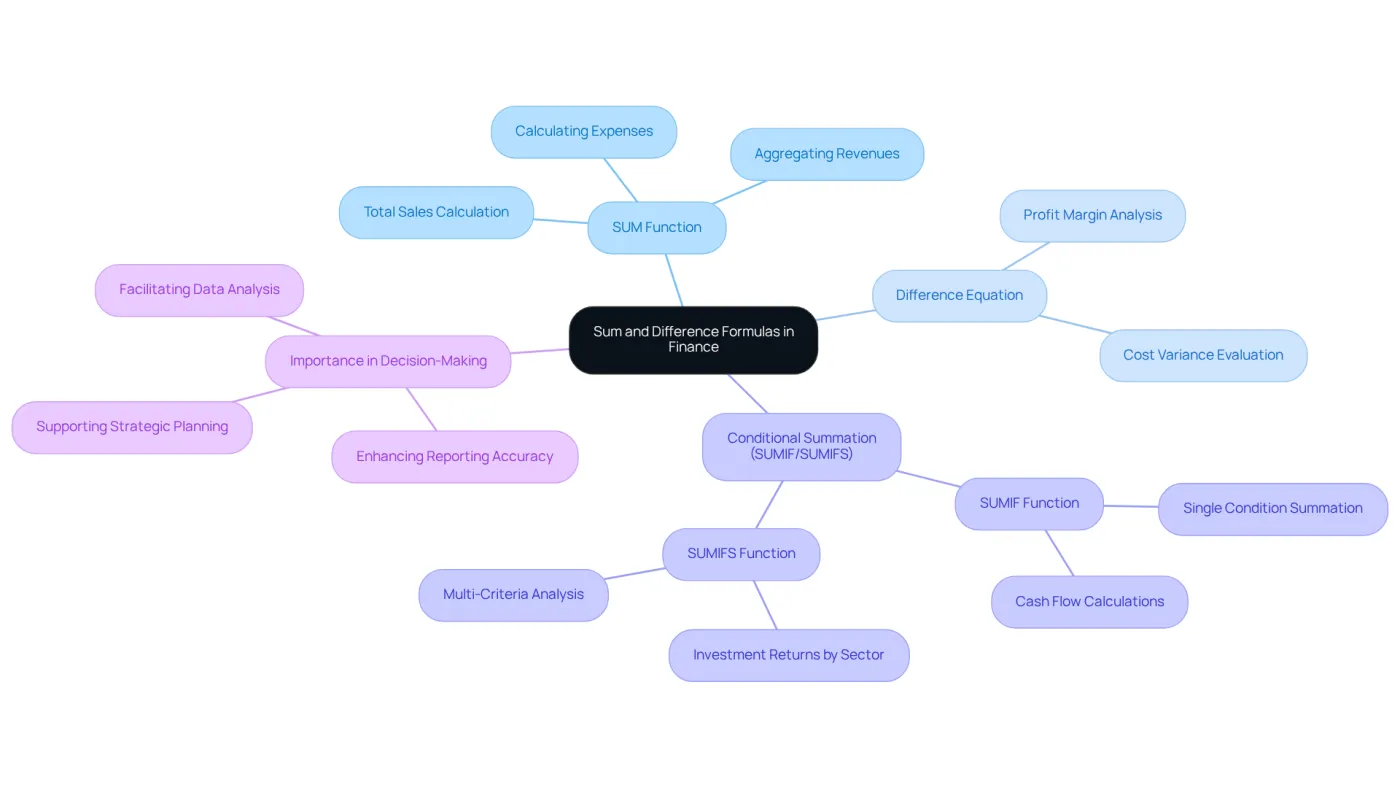
Sum difference formulas play a pivotal role in financial reporting, allowing analysts to combine data and evaluate variances with precision. The SUM function is indispensable for aggregating revenues, expenses, and other critical metrics. Meanwhile, the difference equation is vital for scrutinizing profit margins and cost variances. For example, the expression =SUM(A1:A10) effectively calculates total sales over a designated period, while =A1-B1 helps determine the difference between projected and actual expenses.
Moreover, the SUMIF and SUMIFS functions facilitate conditional summation, which is crucial for analyzing specific segments of data, such as total sales by region or product category. Mastering the sum difference formulas not only enhances accurate reporting but also bolsters decision-making by providing clear insights into economic performance.
As analysts increasingly rely on tools like Google Sheets, understanding these functions becomes essential for effective analysis and strategic planning in 2025. As Warren Buffett wisely stated, 'The first rule of investing is never lose money; the second rule is don’t forget the first rule.' This highlights the critical nature of precise calculations in financial analysis.
Apply Sum and Difference Formulas for Accurate Financial Reporting
Mastering Addition and Subtraction Techniques in Finance
To excel in finance, professionals must adopt a systematic approach to organizing information. Here’s how to do it effectively:
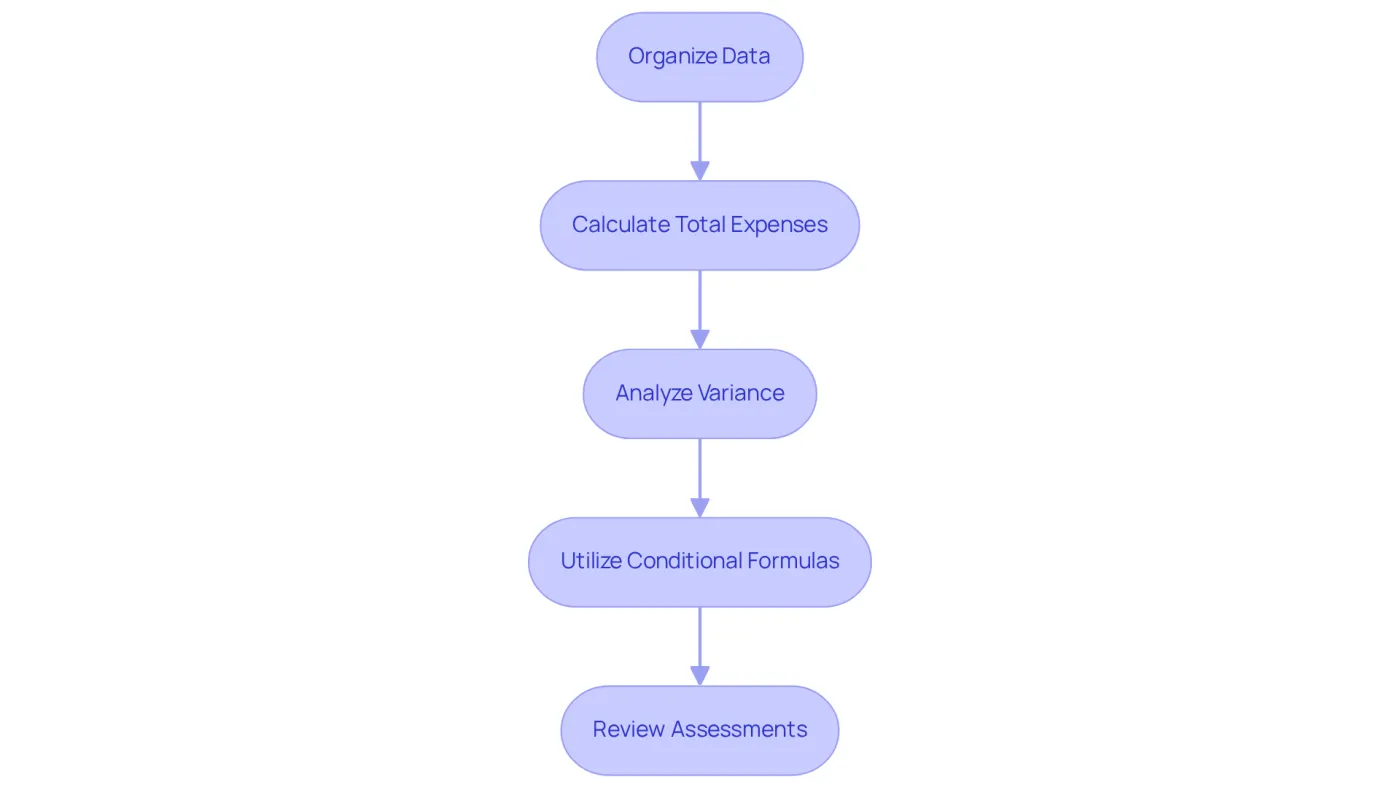
- Organize Data: Start by arranging your data in a clear format. This ensures that all relevant figures are easily accessible, setting the stage for accurate calculations.
- Calculate Total Expenses: Use the equation
=SUM(B2:B10)to determine total expenses, where B2 to B10 contains your expense entries. This foundational step is crucial for financial clarity. - Analyze Variance: For variance analysis, apply the equation
=C2-B2to find the difference between budgeted and actual figures. This analysis provides essential insights into your economic performance. - Utilize Conditional Formulas: Leverage conditional formulas like
SUMIFto enhance the granularity of your monetary reports. This allows you to sum values based on specific criteria, making your reports more informative. - Review Assessments: Regularly verify these assessments against source information to ensure precision and adherence to monetary standards. Consistency is key in maintaining financial integrity.
Boost Your Productivity with ShortieCuts
Additionally, consider utilizing the ShortieCuts extension, which offers 233 Excel ALT shortcuts for Google Sheets. This tool can significantly enhance your productivity. Just hit "ALT" (or Option on Mac) to see key-tips appear in the corner of your screen, making it easier to access essential functions quickly. Statistics show that structured data organization can greatly improve the accuracy of monetary reports, making it a best practice for finance professionals who aim to deliver reliable insights.
Verify Identities and Ensure Compliance in Financial Calculations
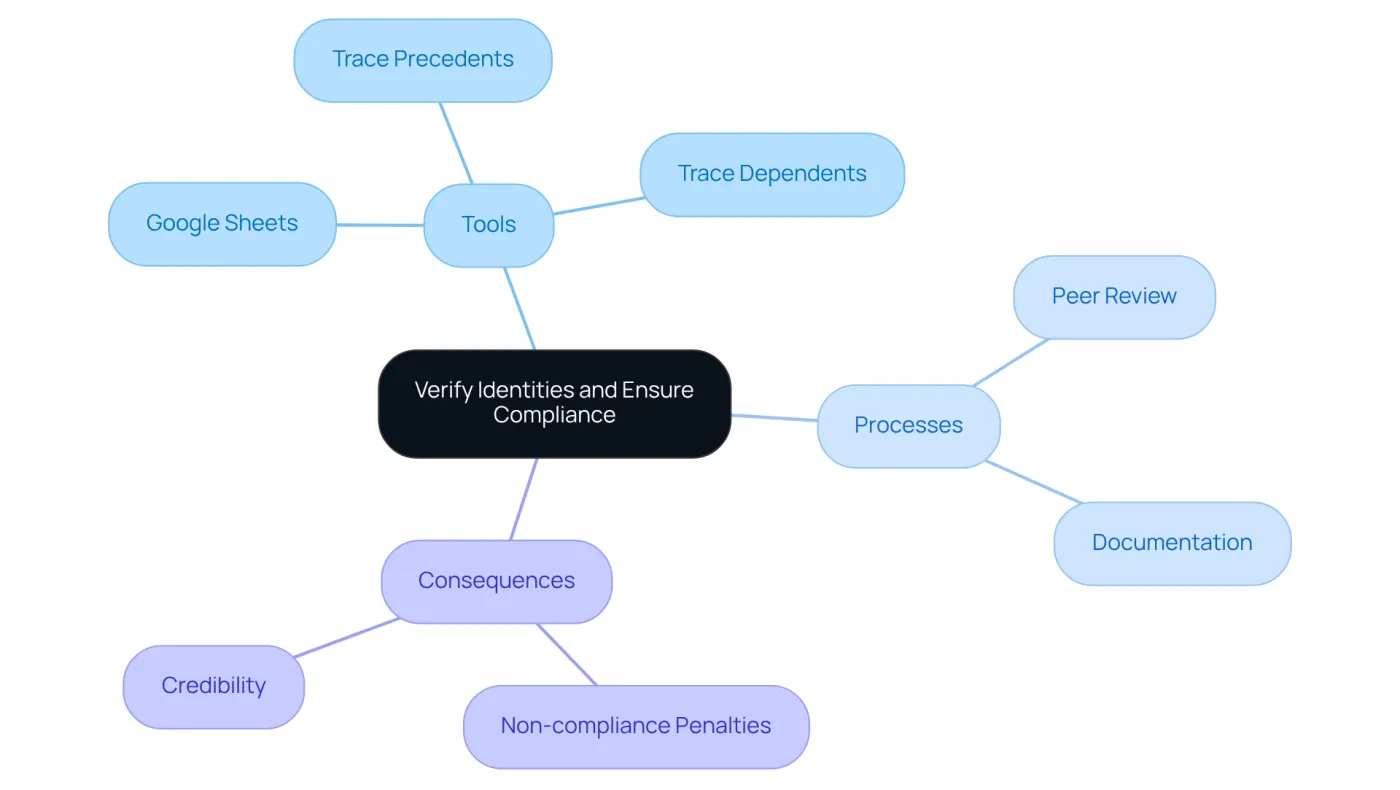
Precision in monetary assessments is paramount for finance experts. The challenge lies in consistently verifying figures against established benchmarks. This is where tools like Google Sheets come into play, significantly streamlining the process. Features such as Trace Precedents and Trace Dependents empower users to identify errors in complex formulas, thereby enhancing the reliability of financial reports.
Moreover, compliance with monetary regulations necessitates meticulous documentation and justification of all calculations. Implementing a peer review process, where calculations are scrutinized, can further bolster accuracy and adherence to standards. This not only protects the integrity of financial reporting but also fosters trust with stakeholders.
Consider this: organizations that prioritize compliance in their reporting processes not only improve accuracy but also build credibility. In fact, non-compliance has led to nearly $4 billion in penalties across global industries in 2022, underscoring the critical need for adherence to financial standards. As Richard Turner aptly states, 'Following accounting laws is to walk the path of financial righteousness.'
In conclusion, the commitment to precision and compliance is not just a regulatory requirement; it is a cornerstone of ethical financial practice.
Leverage Technology to Enhance Formula Implementation in Google Sheets
Optimize Your Financial Calculations with ShortieCuts
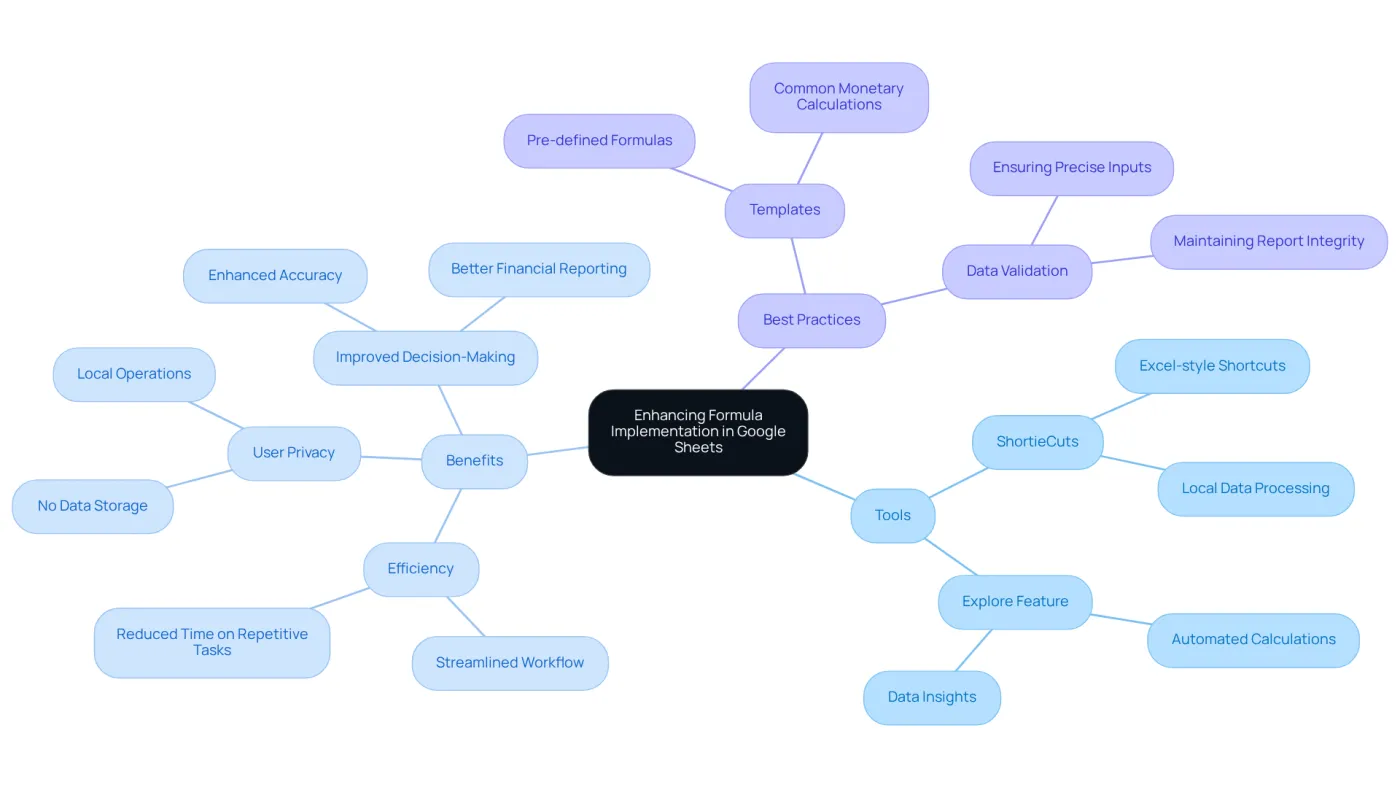
In the fast-paced world of finance, optimizing the implementation of sum and difference formulas in Google Sheets is crucial. Users can leverage built-in features and specialized add-ons to enhance their efficiency. One standout tool is the Explore feature, which offers valuable insights and automates calculations based on current data, significantly improving decision-making processes.
Moreover, ShortieCuts stands out for its commitment to user privacy, as it does not store any data. All operations run locally on your computer, ensuring that your information remains secure. By incorporating ShortieCuts, you gain access to Excel-style shortcuts that streamline the input and alteration of calculations, leading to a more efficient workflow. As one finance expert noted, "Using ShortieCuts has revolutionized how I manage spreadsheets, making intricate computations much easier and quicker."
Additionally, developing templates with pre-defined formulas for common monetary calculations can drastically reduce the time spent on repetitive tasks, enhancing overall productivity. It's also essential to utilize data validation methods to ensure precise inputs, which is vital for maintaining the integrity of financial reports.
By harnessing these technological tools, finance professionals can significantly boost their efficiency and accuracy in financial reporting, ultimately driving better outcomes. Don't miss out on the opportunity to transform your spreadsheet management-start using ShortieCuts today!
Conclusion
Mastering sum and difference formulas is crucial for effective financial reporting. These tools empower analysts to aggregate data and assess variances accurately, leading to informed strategic decision-making and enhanced financial clarity.
Key strategies for implementing these formulas include:
- Organizing data
- Calculating total expenses
- Conducting variance analysis
Compliance and verification in financial calculations are paramount, underscoring the need for meticulous documentation to maintain accuracy and trust with stakeholders. Moreover, leveraging technology, such as Google Sheets and tools like ShortieCuts, can significantly boost efficiency and precision in financial reporting.
The commitment to mastering these formulas streamlines financial processes and reinforces ethical standards in reporting. By prioritizing these practices, finance professionals can ensure their analyses are not only accurate but also compliant with industry regulations. This ultimately leads to better financial outcomes.
Embrace these best practices to elevate your financial reporting and decision-making today. The journey towards excellence in financial analysis starts with the right tools and strategies.
Frequently Asked Questions
What are sum and difference formulas in financial contexts?
Sum and difference formulas are mathematical expressions used in financial reporting to combine data and evaluate variances. They help analysts aggregate revenues, expenses, and other metrics, as well as scrutinize profit margins and cost variances.
How is the SUM function used in financial analysis?
The SUM function is essential for aggregating financial data, such as calculating total sales over a designated period using the expression =SUM(A1:A10).
What is the purpose of the difference equation in financial reporting?
The difference equation, such as =A1-B1, is used to determine the difference between projected and actual expenses, which is vital for analyzing financial performance.
What are SUMIF and SUMIFS functions, and why are they important?
SUMIF and SUMIFS functions allow for conditional summation, enabling analysts to calculate totals based on specific criteria, such as total sales by region or product category. This is crucial for detailed data analysis.
Why is mastering sum and difference formulas important for financial analysts?
Mastering these formulas enhances accurate reporting and supports better decision-making by providing clear insights into economic performance.
How do tools like Google Sheets relate to the use of sum and difference formulas?
As analysts increasingly use tools like Google Sheets for their calculations, understanding sum and difference formulas becomes essential for effective analysis and strategic planning.
What does Warren Buffett's quote about investing imply in the context of financial analysis?
Warren Buffett's quote emphasizes the importance of precise calculations in financial analysis, highlighting that accurate data is crucial for making sound investment decisions.