
Master the Excel Formula Day of Week for Accurate Financial Analysis
Master the excel formula day of week for precise financial analysis and data insights.

Introduction
Understanding the complexities of financial analysis often hinges on the ability to interpret data accurately. One powerful tool at a finance professional's disposal is Excel's WEEKDAY function. This seemingly simple formula can provide valuable insights by categorizing data based on the day of the week. By doing so, it allows users to identify trends and make informed decisions.
However, many finance professionals may overlook the potential pitfalls and complexities that come with its use. How can they ensure they are leveraging the WEEKDAY function effectively? It's essential to enhance analyses while avoiding common errors.
By mastering this function, finance professionals can unlock a wealth of opportunities for deeper insights and more strategic decision-making.
Understand the WEEKDAY Function in Excel
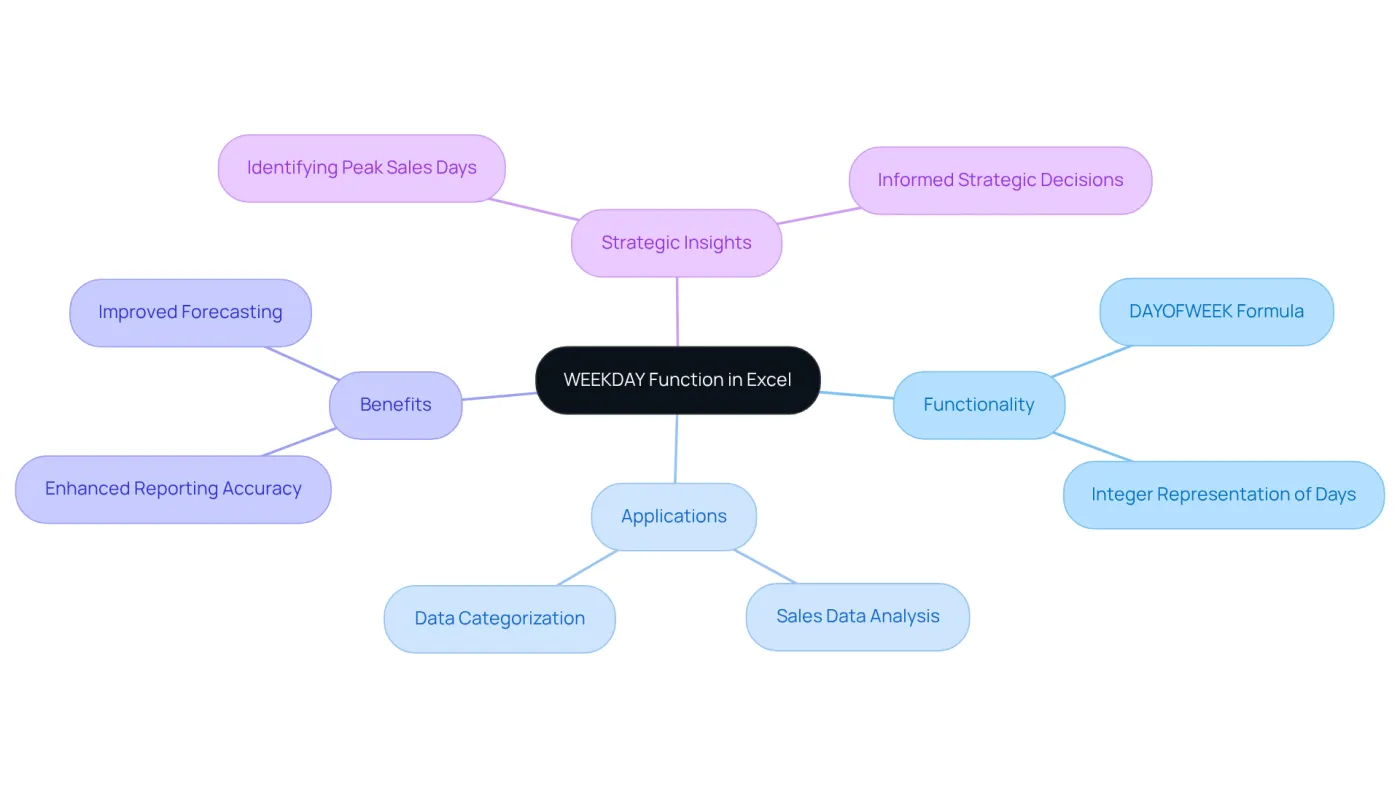
The weekday tool in Excel is an essential asset that utilizes the Excel formula DAYOFWEEK to deliver an integer indicating the day of the week for any given date, where Sunday is marked as 1 and Saturday as 7 by default. This functionality proves invaluable for financial evaluations, allowing users to categorize and analyze data with the Excel formula DAYOFWEEK.
Consider the impact of examining sales data through the lens of the Excel formula DAYOFWEEK tool. By identifying patterns, such as peak sales days, businesses can make informed strategic decisions. Mastering this capability empowers users to conduct deeper analyses, revealing trends in financial performance over time.
Segmenting data by weekdays not only enhances reporting accuracy but also bolsters forecasting and planning efforts. By leveraging the weekday tool, finance professionals can unlock insights that drive better decision-making and optimize their strategies.
Apply the WEEKDAY Function Effectively
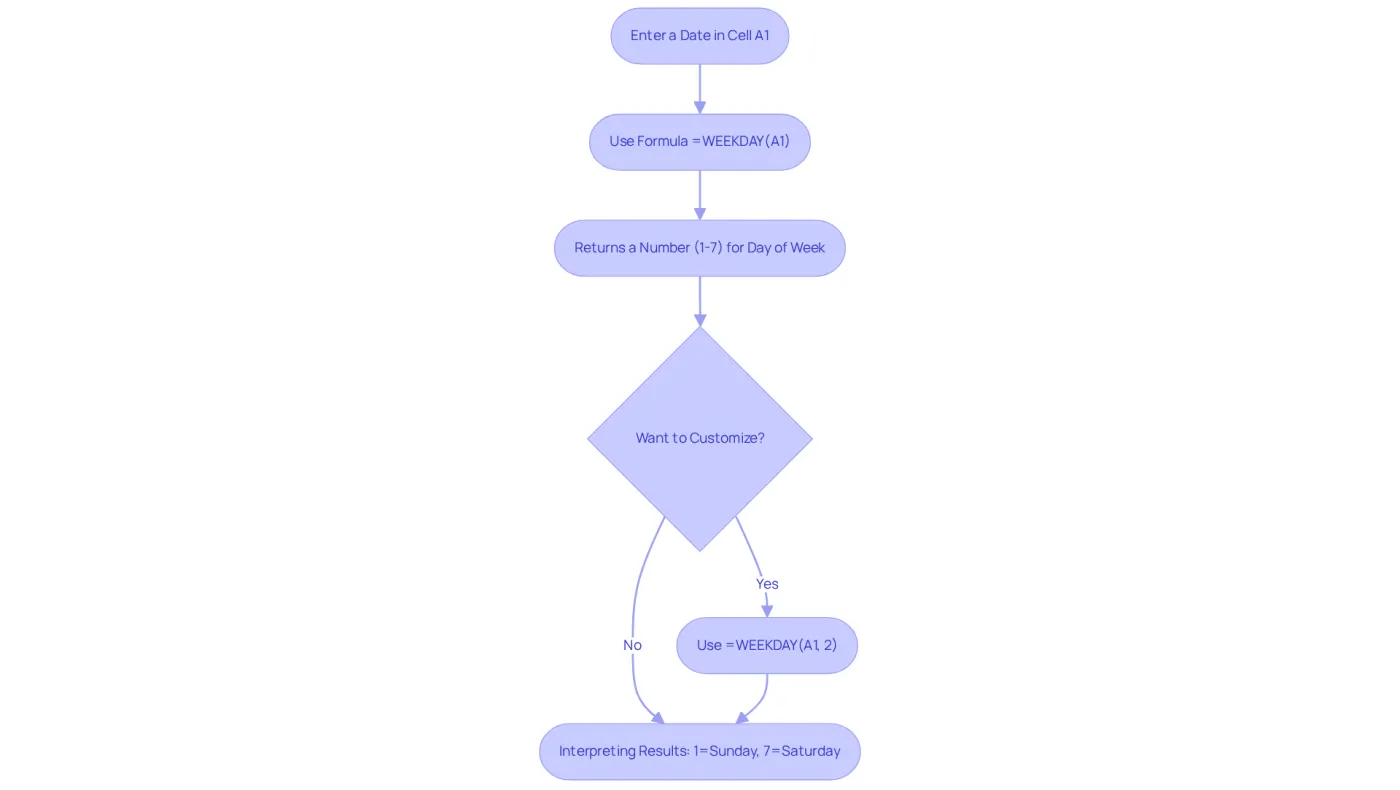
To effectively apply the excel formula day of week, start by entering a date in a cell, such as A1. In another cell, use the excel formula day of week, which is =WEEKDAY(A1). This will yield a number that corresponds to the day of the week. For example, if A1 contains '2025-12-21', the formula will return 7, indicating that it's a Saturday.
You can personalize this feature by adding a second argument to modify the numbering system. For instance, =WEEKDAY(A1, 2) will return 6 for Saturday, as it starts counting from Monday. This flexibility allows you to tailor the function to meet your specific analysis needs, whether you're using an excel formula day of week to filter data for weekdays or weekends.
According to statistics, the WEEKDAY function in the excel formula day of week assigns a number from 1 (Sunday) to 7 (Saturday), which is crucial for accurate data evaluation. Expert Dave Bruns notes, "By default, the function returns 1 for Sunday and 7 for Saturday, but this is adjustable."
Moreover, case studies like 'Filtering Workdays' demonstrate how this feature can streamline data analysis by isolating workdays, thereby enhancing the precision of financial models. Be mindful of common pitfalls, such as ensuring the correct return_type is used to avoid misinterpretations of the output.
Customize Outputs with Advanced WEEKDAY Techniques
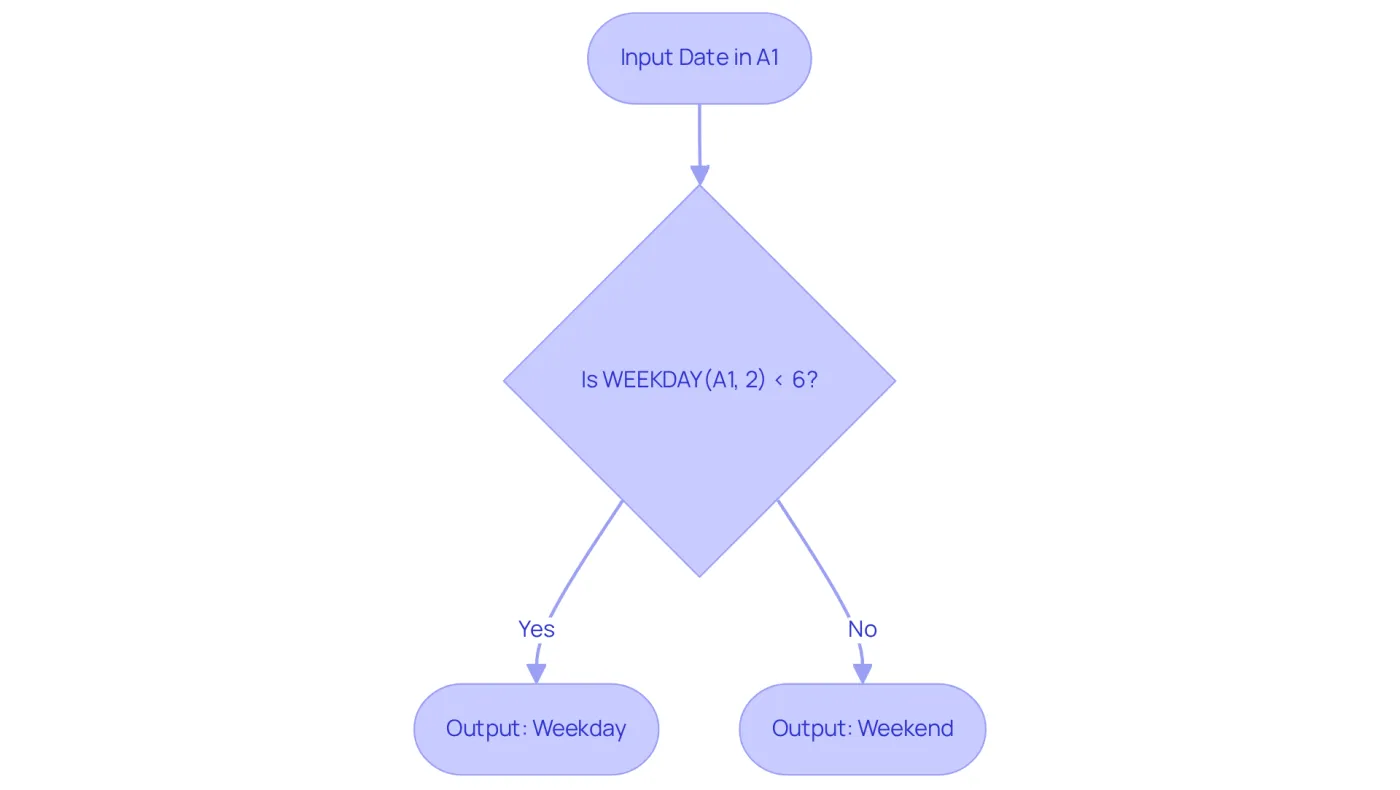
Customizing outputs with the excel formula day of week can significantly enhance your data analysis capabilities. By combining it with other functions like IF or TEXT, you can create a powerful excel formula day of week that categorizes days into 'Weekday' or 'Weekend.' For instance, consider this formula: =IF(WEEKDAY(A1, 2) < 6, 'Weekday', 'Weekend'). This checks if the day falls between Monday and Friday, providing the appropriate label.
Moreover, the TEXT function allows you to display the day name instead of a number. Using =TEXT(A1, 'dddd'), you can easily return 'Saturday' for the date in A1. These advanced techniques not only streamline your analysis but also make it easier to identify trends and patterns in financial data.
However, it's crucial to be aware of common pitfalls. Misapplying the weekly calculation by overlooking the return_type can lead to incorrect categorizations. By effectively utilizing these capabilities, finance professionals can enhance their decision-making processes. Understanding the distinction between weekday and weekend data is vital for comprehending user behavior and optimizing financial strategies.
Troubleshoot Common WEEKDAY Function Issues
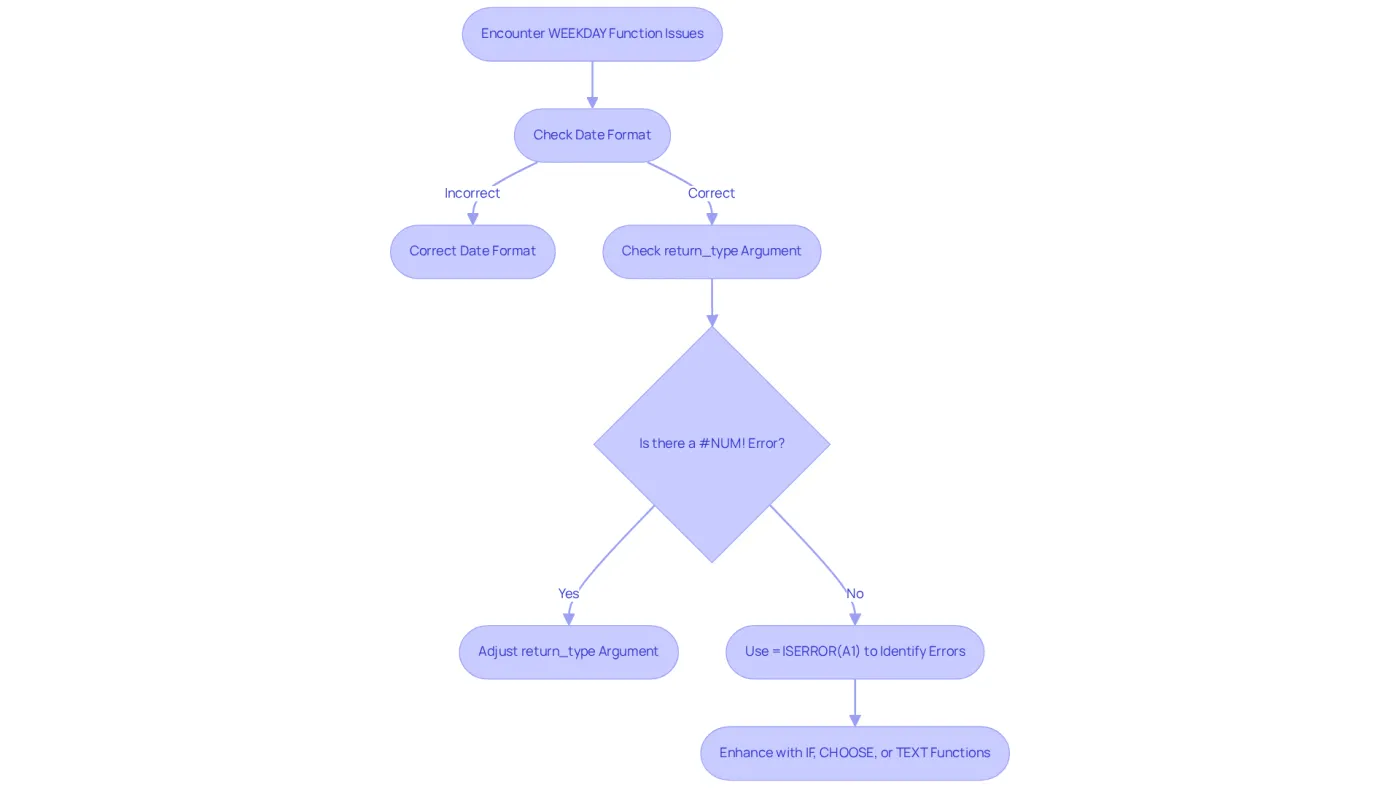
Common problems with an Excel formula day of week calculations often stem from incorrect date formats. Are you struggling with errors in your Excel sheets? If so, the first step is to ensure that the date in the referenced cell is formatted correctly as a date, not as text. For example, inputting '12/21/2025' as text can prevent the day of the week calculation from functioning properly.
Moreover, check that the return_type argument is within the acceptable range; otherwise, you may encounter a #NUM! error. Did you know that around 30% of finance users experience date format errors in Excel? These mistakes can lead to significant miscalculations in financial evaluations.
If you continue to face issues, consider using the =ISERROR(A1) formula to identify if the Excel formula day of week operation is causing an error. Additionally, using the Excel formula day of week in combination with functions like IF, CHOOSE, or TEXT can greatly enhance its utility in your evaluations.
By understanding these common pitfalls and employing these troubleshooting techniques, you can significantly improve the accuracy of your financial analyses. Don't let date format errors derail your work-take action now to ensure your calculations are precise and reliable.
Conclusion
Mastering the Excel formula WEEKDAY can significantly enhance financial analysis, empowering professionals to derive meaningful insights from their data. By effectively utilizing the WEEKDAY function, users can categorize days, identify trends, and make informed decisions that drive business success. This foundational tool not only streamlines reporting but also enhances forecasting capabilities, making it indispensable for finance experts.
Throughout this article, we explored key strategies for applying the WEEKDAY function, including its basic usage, customization techniques, and troubleshooting common issues. Understanding the function's syntax and employing advanced formulas with IF statements contributes to a more nuanced approach to financial data analysis. Recognizing the importance of accurate date formatting and return types ensures that users can avoid typical pitfalls that could compromise their evaluations.
Ultimately, leveraging the WEEKDAY function in Excel is not just about performing calculations; it unlocks the potential for deeper insights and more strategic decision-making. Finance professionals are encouraged to embrace these techniques, ensuring that their analyses are precise and reflective of real-world patterns. By mastering this essential tool, users can enhance their financial planning and analysis efforts, paving the way for more effective strategies and improved outcomes.
Frequently Asked Questions
What is the WEEKDAY function in Excel?
The WEEKDAY function in Excel is a tool that uses the DAYOFWEEK formula to return an integer representing the day of the week for a given date, with Sunday as 1 and Saturday as 7 by default.
How can the WEEKDAY function be useful in financial evaluations?
The WEEKDAY function helps categorize and analyze data by identifying patterns, such as peak sales days, which can inform strategic decisions for businesses.
What insights can be gained by using the WEEKDAY function on sales data?
By examining sales data through the WEEKDAY function, businesses can reveal trends in financial performance over time, leading to better forecasting and planning.
How does segmenting data by weekdays improve reporting accuracy?
Segmenting data by weekdays enhances reporting accuracy by allowing finance professionals to analyze and understand the performance variations across different days of the week, leading to more informed decision-making.
What is the significance of mastering the WEEKDAY function for finance professionals?
Mastering the WEEKDAY function empowers finance professionals to conduct deeper analyses, unlock insights, and optimize their strategies based on trends observed in data categorized by weekdays.