

Overview
This article presents a comprehensive guide on mastering the Excel formula for standard deviation in four straightforward steps, underscoring its critical role in financial analysis. It highlights the significance of standard deviation in evaluating investment risk, delineates the differences between the STDEV.P and STDEV.S functions for population and sample data, and provides precise, step-by-step instructions for accurate calculations. By doing so, it empowers users to analyze data variability effectively and make informed financial decisions.
Introduction
Understanding the intricacies of standard deviation is essential for anyone navigating the complex world of finance. This statistical measure quantifies the variability of investment returns and serves as a critical tool for assessing risk and making informed decisions. As financial markets become increasingly unpredictable, mastering the Excel formula for standard deviation empowers investors to refine their strategies and enhance portfolio performance.
However, with two distinct functions—STDEV.P and STDEV.S—available, many may question which method to apply. It is crucial to avoid common pitfalls in these calculations.
Understand Standard Deviation and Its Importance in Finance
The excel formula for standard deviation is a crucial statistical measure that quantifies the variation or dispersion within a set of values, particularly in the realm of finance. It plays a vital role in helping investors assess the potential volatility of their investments. A greater variance indicates higher volatility, which frequently relates to elevated risk. For instance, an investment with a typical variation of 15% suggests that its returns may vary by 15% higher or lower than the average return. This variability is essential for investors to understand, as it directly influences their risk tolerance and investment strategies.
In practical terms, the excel formula for standard deviation assists in portfolio management by enabling investors to assess the uncertainty linked to their investments. A portfolio with a typical variation of 10.34% implies a moderate level of risk. Conversely, a stock such as SPY (S&P 500 ETF), recognized for its greater price volatility and deemed riskier, generally displays a larger variation, suggesting less predictable returns. This understanding enables investors to tailor their portfolios according to their risk preferences, balancing potential returns against the inherent risks.
However, depending exclusively on typical variation to forecast future results can be deceptive due to unexpected market occurrences. Historical data indicates that:
- 68% of returns will be within one range of the average
- 95% will be within two ranges
Nevertheless, these figures do not guarantee future outcomes, emphasizing the need for a comprehensive approach to risk assessment.
Recent evaluations emphasize that the typical combined portfolio worth, considering variability, can greatly influence investment choices. For instance, a fixed annuity with a guaranteed return shows no variability, providing predictability. In contrast, a mixed portfolio brings uncertainty with a variability of 15.24%. Understanding these dynamics is essential for finance professionals aiming to optimize their investment strategies with an excel formula for standard deviation that aligns with their risk tolerance.

Choose the Right Excel Function: STDEV.P vs. STDEV.S
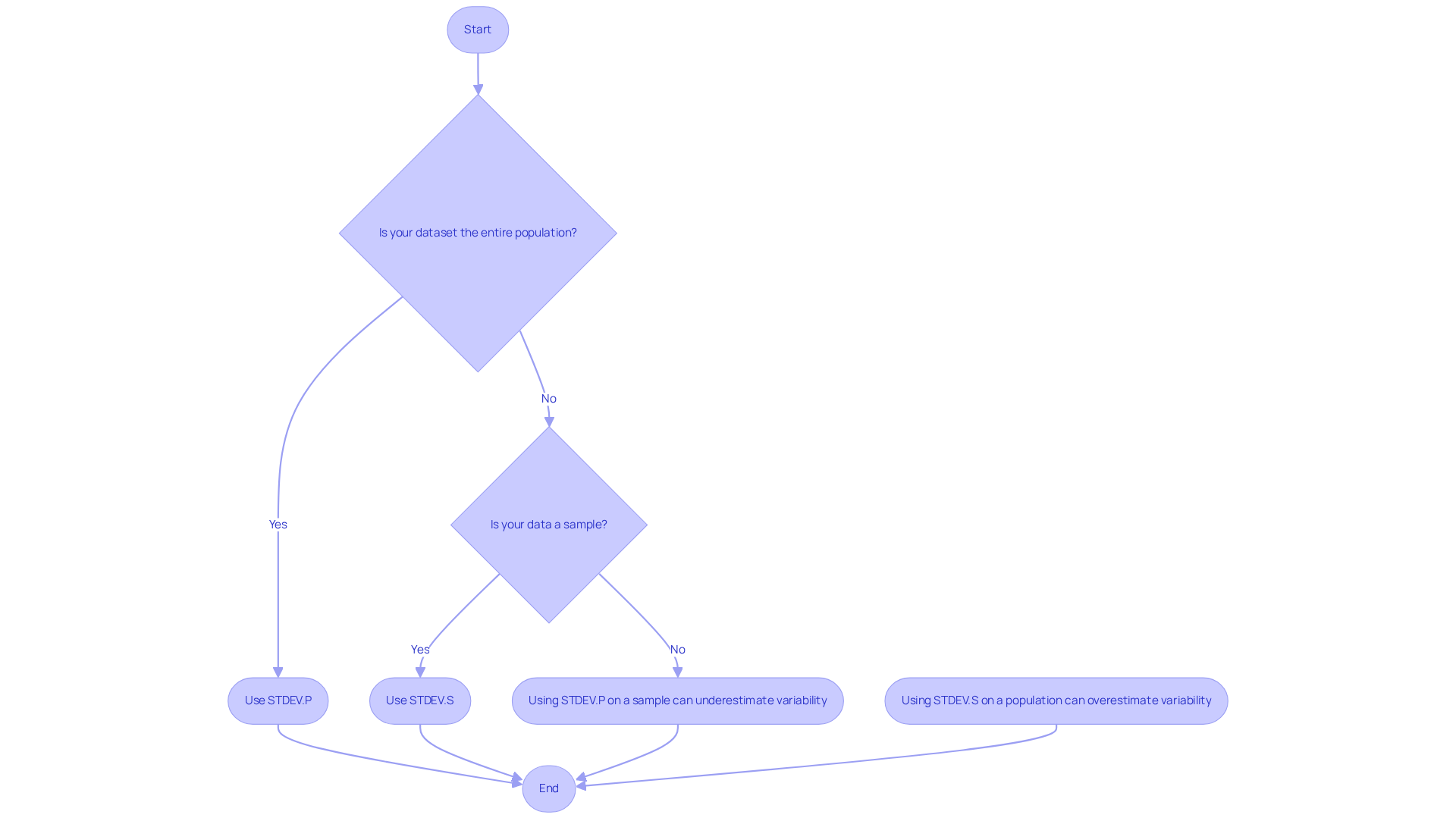
In Excel, two primary operations crucial for calculating standard deviation are the excel formula for standard deviation: STDEV.P and STDEV.S. The STDEV.P formula is employed when your dataset represents the entire population, providing an exact measure of variability. For instance, if you have comprehensive sales data for a year, STDEV.P is the appropriate choice. The correct syntax for this operation using the excel formula for standard deviation is =STDEV.P(number1, [number2],…). Conversely, the excel formula for standard deviation, STDEV.S, is intended for samples, applying Bessel’s correction to address potential underestimations of variability. For example, if your data includes only a subset of sales, the excel formula for standard deviation would be STDEV.S, with the syntax being =STDEV.S(number1, [number2],…).
Selecting the correct method, such as the excel formula for standard deviation, is vital for ensuring accurate outcomes. Utilizing STDEV.P on a sample can lead to an underestimation of variability, while applying STDEV.S to a complete population may result in an overestimation. Common errors include omitting parentheses or misplacing commas in inputs, which can lead to mistakes or erroneous analysis results. Financial analysts emphasize that understanding the context of your data is critical; improper use of the excel formula for standard deviation can distort analysis results, impacting decision-making processes. For instance, a portfolio manager relying on STDEV.S for full census data might misinterpret risk assessments, resulting in flawed investment strategies. Therefore, mastering the excel formula for standard deviation is essential for effective financial modeling and analysis.
Calculate Standard Deviation in Excel: Step-by-Step Instructions
Calculating the average spread in Excel can be easily done using the excel formula for standard deviation, which significantly enhances your financial modeling capabilities. Here’s how to perform this calculation effectively:
-
Enter Your Information: Start by inputting your data into a single column in an Excel worksheet. For example, you might place your values in cells A1 to A10.
-
Select the Cell for the Result: Click on the cell where you wish to display the standard deviation result.
-
Choose the Function: Depending on your dataset, enter
=STDEV.S(A1:A10)if your numbers represent a sample, or=STDEV.P(A1:A10)if they encompass the entire population. Be sure to replaceA1:A10with the actual range of your data. -
Press Enter: Hit the Enter key, and Excel will compute the typical variation for the specified range. The result will appear in the selected cell, providing insights into the variability of your data.
Understanding how to utilize the excel formula for standard deviation is crucial for finance professionals, as it aids in assessing data reliability and identifying trends. Recent tutorials underscore the importance of using the excel formula for standard deviation—STDEV.S for samples and STDEV.P for populations—to ensure precise outcomes. In financial modeling, this knowledge can inform decisions related to risk assessment and inventory management, particularly when analyzing sales data that may exhibit significant variability. For instance, a sample of daily sales figures might show a typical variation of approximately 440.17, with an average sales value of $975. By mastering these calculations, you can refine your analytical skills and make more informed decisions based on your data. Additionally, incorporating variability bars in your Excel charts can visually represent fluctuations, further aiding in effective analysis.

Troubleshoot Common Issues in Standard Deviation Calculations
Calculating standard deviation using an excel formula for standard deviation in Excel can pose several challenges that may lead to inaccurate results. Below are common issues and their solutions:
-
Incorrect Information Formatting: Ensure that all entries are formatted as numbers. Cells formatted as text will be excluded from calculations, potentially skewing results. Notably, most decimal fractions cannot be represented exactly in 64-bit binary floating-point format, which can lead to inaccuracies.
-
Missing Values: Blank cells or errors (such as #N/A) can disrupt calculations. Utilize the
IFERRORtool to manage errors effectively and maintain information integrity. This is crucial, as approximately 95% of data falls within two typical ranges of the average, making precise calculations essential for reliable analysis. -
Using the Wrong Function: Confirm whether to use STDEV.P or STDEV.S based on your dataset. Using the incorrect function can yield misleading results; STDEV.P is meant for entire populations, while STDEV.S is intended for samples. Generally, apply STDEV.S when obtaining a sample from a larger population.
-
Outliers: Extreme values can significantly influence calculations of variation. Review your dataset for outliers and decide whether to include or exclude them based on your analytical objectives. A significant variation indicates greater inconsistency, which can impact financial decisions.
By addressing these common mistakes, users can enhance the accuracy of their statistical calculations, particularly when using the excel formula for standard deviation, leading to more reliable data analysis results. As Arunn Thevapalan highlights, standard deviation is crucial in evaluating the accuracy of a regression model, as it quantifies the spread of the residuals, which are the errors in the model's predictions.

Conclusion
Mastering the Excel formula for standard deviation is crucial for anyone aiming to enhance their financial analysis expertise. This guide has illuminated the significance of standard deviation in finance, underscoring its role in evaluating investment volatility and risk. By grasping how to calculate this vital metric using Excel, investors can make informed decisions that align with their risk tolerance and investment strategies.
The article delineated the differences between the STDEV.P and STDEV.S functions, highlighting the importance of selecting the appropriate method based on whether the dataset represents a complete population or a sample. Step-by-step instructions provided a clear pathway for calculating standard deviation in Excel, while troubleshooting tips addressed common issues that could lead to inaccurate results. This comprehensive approach ensures that users possess the knowledge required to leverage standard deviation effectively in their financial modeling.
In an era where data-driven decisions are paramount, mastering the Excel formula for standard deviation can significantly enhance analytical capabilities. By applying these insights, finance professionals can refine their investment strategies, minimize risks, and ultimately achieve superior financial outcomes. Embracing the power of standard deviation not only aids in comprehending market behavior but also empowers investors to navigate the complexities of financial decision-making with confidence.
Frequently Asked Questions
What is standard deviation and why is it important in finance?
Standard deviation is a statistical measure that quantifies the variation or dispersion within a set of values. In finance, it helps investors assess the potential volatility of their investments, with greater variance indicating higher volatility and associated risk.
How does standard deviation influence investment strategies?
Understanding standard deviation allows investors to gauge the risk associated with their investments. A higher typical variation suggests more unpredictable returns, which can affect an investor's risk tolerance and the strategies they choose for portfolio management.
What does a typical variation of 15% signify for an investment?
A typical variation of 15% indicates that the investment's returns may fluctuate by 15% higher or lower than the average return, highlighting the potential volatility and risk involved.
How can the excel formula for standard deviation assist in portfolio management?
The excel formula for standard deviation helps investors evaluate the uncertainty linked to their investments, allowing them to balance potential returns against inherent risks based on the variability of their portfolio.
What does a typical variation of 10.34% imply about a portfolio?
A typical variation of 10.34% implies a moderate level of risk associated with the portfolio, suggesting that the returns are relatively stable compared to investments with higher variations.
What are the historical data percentages related to returns and their relation to average?
Historical data indicates that 68% of returns will fall within one standard deviation of the average, while 95% will be within two standard deviations. However, these figures do not guarantee future outcomes.
How does variability affect different types of investments?
Investments like fixed annuities, which have guaranteed returns and no variability, provide predictability. In contrast, mixed portfolios may exhibit higher variability, such as 15.24%, introducing more uncertainty in returns.
Why is a comprehensive approach to risk assessment necessary?
Relying solely on typical variation to predict future results can be misleading due to unexpected market occurrences, necessitating a comprehensive approach to effectively assess and manage risk in investment strategies.