
Master the Formula to See If Two Cells Match in Excel
Learn how to effectively use the formula to see if two cells match in Excel for accurate data analysis.

Introduction
Evaluating data accuracy is crucial in any analytical role, particularly in finance, where precision can significantly impact critical decisions. Excel equips users with robust tools to compare cell values, allowing for the swift identification and resolution of discrepancies. But with various methods at your disposal - from the simple equals operator to more intricate functions like IF and MATCH - how do you choose the best approach for your specific needs?
This article explores essential techniques for comparing cells in Excel, empowering you with the skills necessary to enhance your data analysis and sidestep common pitfalls. By mastering these methods, you can ensure that your financial decisions are based on accurate and reliable data.
Understand the Basics of Cell Comparison in Excel
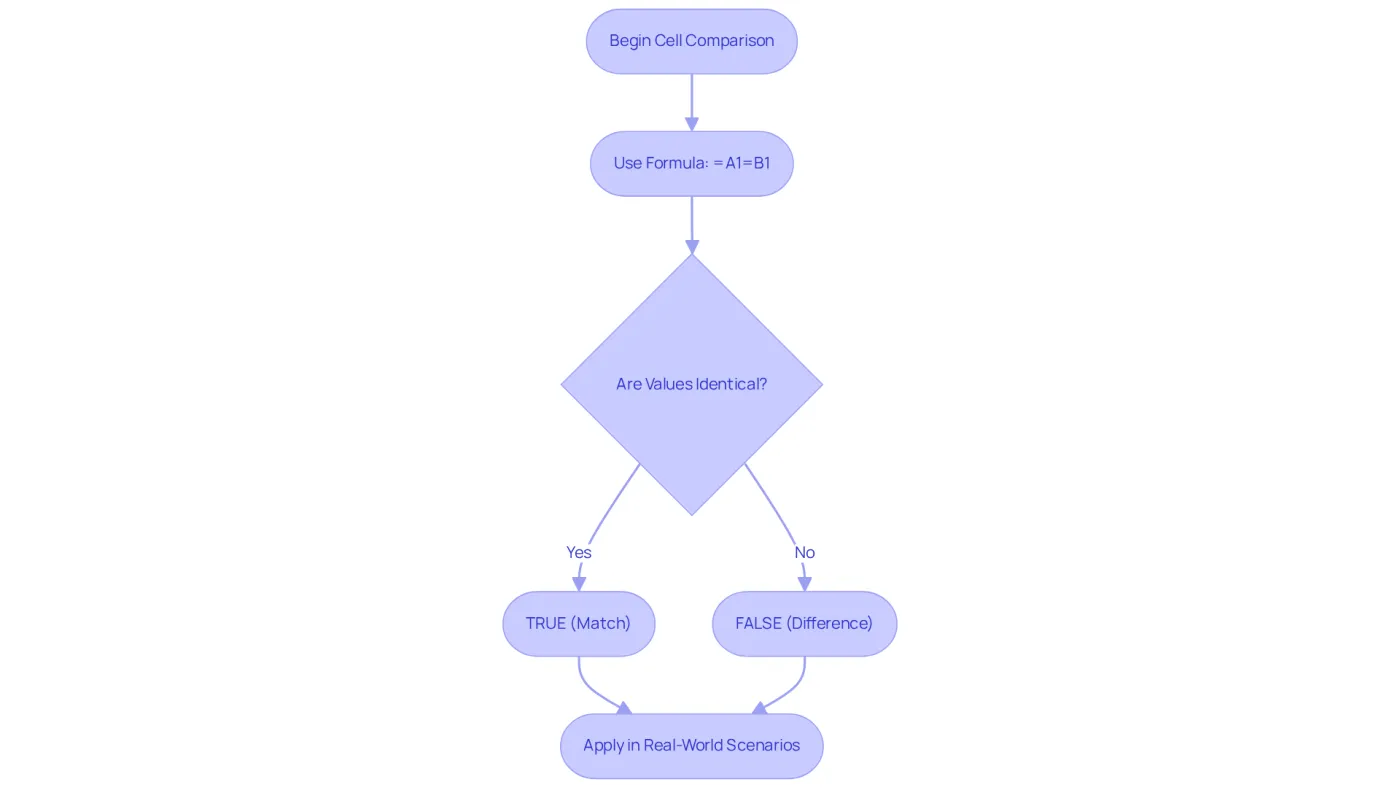
Evaluating data in Excel is a crucial skill that every finance professional should master. It involves using a formula to see if two cells match in order to assess the contents of two or more entries and determine their equivalence. The simplest and most effective method for this is the equals operator (=). For example, the formula to see if two cells match can be entered as =A1=B1 in a separate cell, which will yield TRUE if the values in cells A1 and B1 are identical, and FALSE if they differ. This fundamental evaluation lays the groundwork for more complex formulas and functions that enhance analytical capabilities.
Recent updates in Excel have streamlined this process even further. The introduction of the =COPILOT function allows users to incorporate dynamic information updates into their evaluations, significantly boosting productivity. Notably, statistics reveal that around 70% of spreadsheet users rely on the equals operator for cell comparisons, underscoring its vital role in everyday tasks.
The real-world applications of the equals operator are extensive. Finance professionals frequently use the formula to see if two cells match to verify matching entries in budget sheets or to compare forecasted versus actual figures. By mastering this operator, users can efficiently analyze information, ensuring accuracy and consistency in their reports.
In summary, understanding how to use the equals operator is essential for anyone looking to leverage spreadsheet software for effective data analysis. Embrace this skill to enhance your analytical prowess and elevate your reporting accuracy.
Explore Formulas for Matching Cells: IF, MATCH, and Equals Operator
Excel offers several effective formulas for comparing cell values, each designed to meet specific needs:
- Equals Operator: The simplest method is the equals operator (
=). For example, the formula to see if two cells match is=A1=B1, which checks whether the values in A1 and B1 are identical. - IF Function: This function allows for conditional comparisons. For instance,
=IF(A1=B1, "Match", "No Match")returns 'Match' if the cells are equal and 'No Match' if they differ. This is particularly useful when applying a formula to see if two cells match for quick assessments. However, it's important to note that the spreadsheet application cannot compare different types of information, such as text with numbers or dates, without proper formatting. - MATCH Function: This function searches for a specified item within a range and returns its position. For example,
=MATCH(A1, B:B, 0)identifies the location of the value in A1 within column B. This is especially advantageous for analysis, as the MATCH function is widely utilized among Excel users, reflecting its effectiveness in various financial contexts.
These formulas, such as the formula to see if two cells match, empower users to perform accurate comparisons in their spreadsheets, enhancing information accuracy and decision-making capabilities. Additionally, understanding the limitations of nesting IF functions is crucial. Users can nest up to 64 IF functions, which can lead to complex and potentially error-prone formulas. By incorporating these insights, you can significantly improve the effectiveness of financial modeling and data analysis.

Apply Formulas Step-by-Step to Compare Two Cells
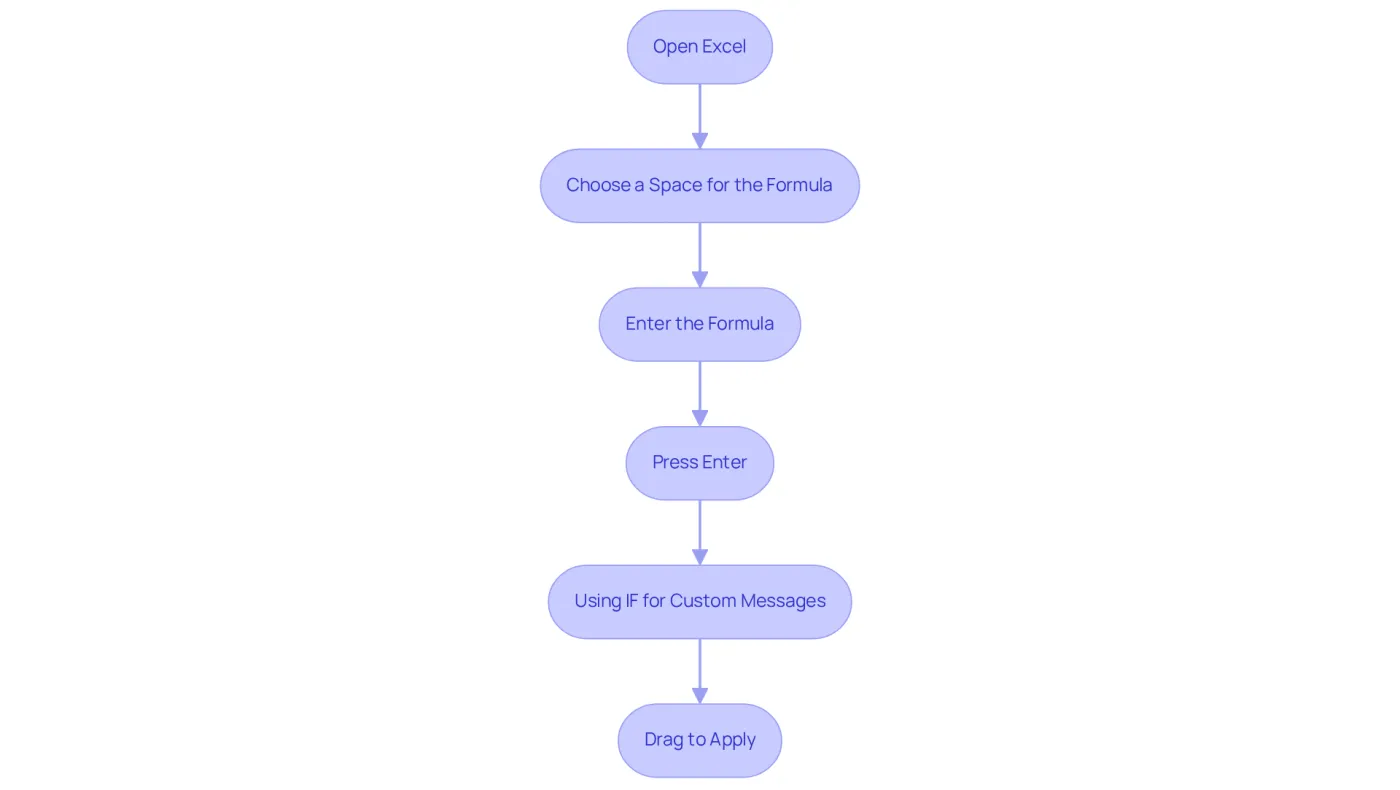
To effectively compare two cells in Excel, follow these straightforward steps:
- Open Excel: Launch the Excel application and access your spreadsheet.
- Choose a Space for the Formula: Click on an unoccupied area where you want the comparison result to display.
- Enter the Formula: Input
=A1=B1(substituting A1 and B1 with the actual references you wish to compare). - Press Enter: Hit the Enter key to execute the formula. The compartment will show
TRUEif the values correspond orFALSEif they do not. - Using IF for Custom Messages: For a custom message instead of TRUE/FALSE, utilize the IF function. Type
=IF(A1=B1, "Match", "No Match")and press Enter. This will show 'Match' or 'No Match' based on the comparison. - Drag to Apply: To compare multiple rows, click on the fill handle (the small square at the bottom-right corner of the cell) and drag it down to apply the formula to additional cells.
Mastering these formulas can significantly enhance your analytical efficiency, especially in finance and information-intensive roles. In fact, studies show that 38% of work involves spreadsheets, underscoring the importance of these skills. Typically, users may require a few hours to achieve proficiency in these techniques, particularly if they have prior experience with spreadsheets. As one instructor noted, "Mastering basic formulas is essential for anyone aiming to excel in information analysis." This foundational knowledge is crucial for tackling more complex data manipulation tasks.
Troubleshoot Common Issues in Cell Comparison
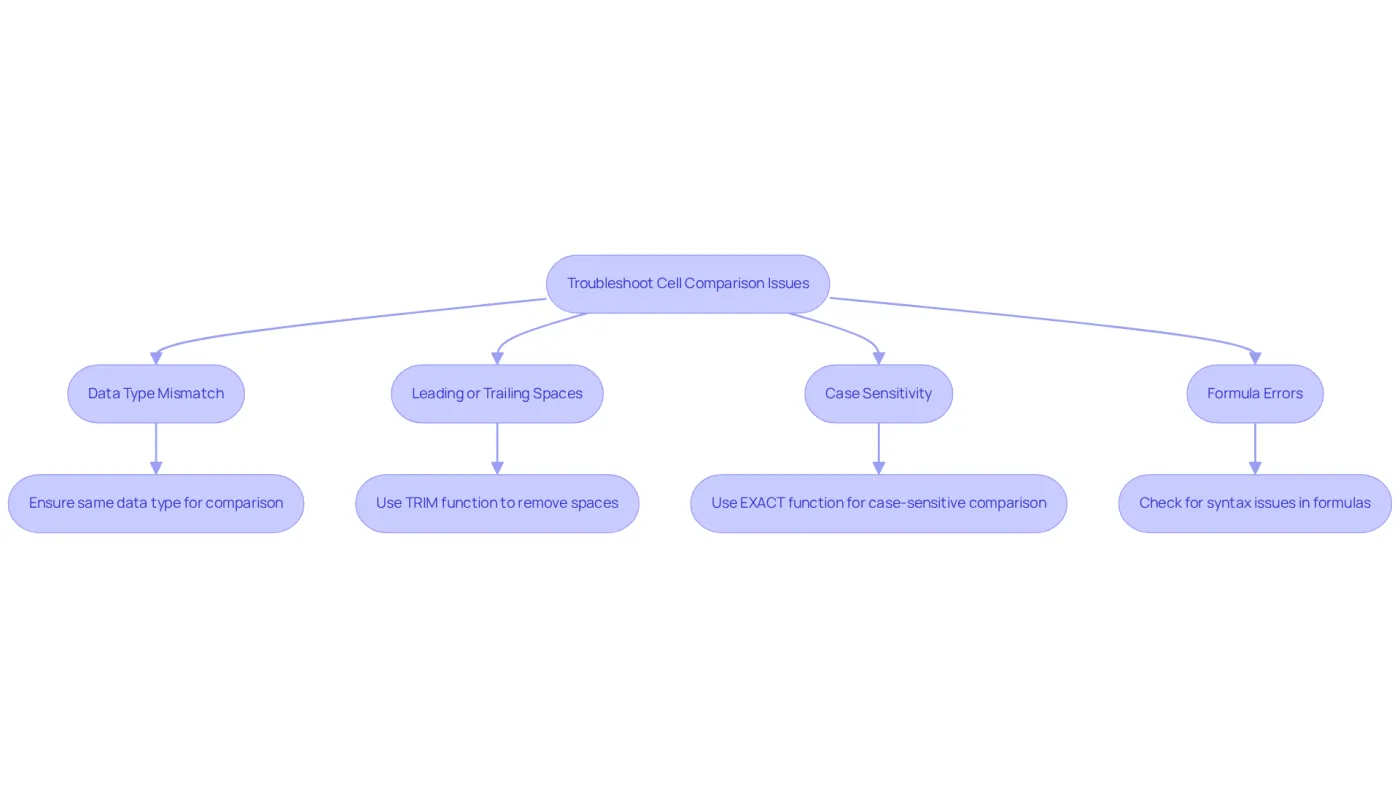
When comparing cells in Excel, users often face several common issues that can hinder their work:
-
Data Type Mismatch: It's crucial to ensure that both fields being compared share the same data type. For instance, if one cell is formatted as text and the other as a number, the evaluation may return FALSE. This simple oversight can lead to significant errors in your data analysis.
-
Leading or Trailing Spaces: Extra spaces can cause evaluations to fail. To avoid this, utilize the TRIM function to eliminate unnecessary spaces. For example, you can use the formula
=TRIM(A1)=TRIM(B1)to ensure a clean comparison. -
Case Sensitivity: The equals operator in Excel is not case-sensitive. If you require a case-sensitive comparison, the EXACT function is your go-to solution:
=EXACT(A1, B1). This function ensures that your comparisons are precise and accurate. -
Formula Errors: If your formula returns an error, it’s essential to check for syntax issues or verify that the referenced cells contain valid data. Excel's error-checking features can help identify and resolve these issues effectively.
By addressing these common pitfalls, you can improve your efficiency and accuracy in Excel by using a formula to see if two cells match, leading to more reliable data analysis.
Conclusion
Mastering the art of cell comparison in Excel is not just a skill; it’s a game changer for anyone serious about data analysis. By utilizing the equals operator alongside functions like IF and MATCH, you can efficiently determine whether two cells match. This capability paves the way for informed decision-making, streamlining financial reporting while ensuring accuracy and consistency across your data entries.
Key insights from this guide underscore the necessity of proper formatting and awareness of common pitfalls - think data type mismatches and extra spaces - that can lead to costly errors. By adopting a systematic approach to cell comparison, you’ll quickly spot discrepancies, enhancing your analytical efficiency. Plus, leveraging cutting-edge Excel features like the =COPILOT function can elevate your productivity even further.
Ultimately, embracing these techniques is crucial for anyone aiming to excel in data analysis and financial modeling. Investing time in mastering these foundational formulas and troubleshooting common issues will unlock Excel’s full potential, transforming your approach to data management and analysis. Take the first step today by applying these strategies, and watch your proficiency in Excel soar, leading to more accurate and insightful outcomes in your work.
Frequently Asked Questions
What is the purpose of cell comparison in Excel?
Cell comparison in Excel is used to evaluate data by determining if two cells match, which helps assess the contents of entries and their equivalence.
How do you perform a basic cell comparison in Excel?
A basic cell comparison can be performed using the equals operator (=). For example, you can enter the formula =A1=B1 in a separate cell, which will return TRUE if the values in cells A1 and B1 are identical, and FALSE if they differ.
What recent updates have improved the cell comparison process in Excel?
The introduction of the =COPILOT function allows users to incorporate dynamic information updates into their evaluations, enhancing productivity in cell comparisons.
How commonly is the equals operator used for cell comparisons?
Around 70% of spreadsheet users rely on the equals operator for cell comparisons, highlighting its importance in everyday tasks.
What are some real-world applications of the equals operator in finance?
Finance professionals use the equals operator to verify matching entries in budget sheets and to compare forecasted versus actual figures, ensuring accuracy and consistency in their reports.
Why is understanding the equals operator important for data analysis?
Mastering the equals operator is essential for leveraging spreadsheet software effectively, as it enhances analytical capabilities and improves reporting accuracy.