
Master the XIRR Calculation Formula in Google Sheets: A Complete Guide
Learn how to use the XIRR calculation formula in Google Sheets for accurate financial analysis.

Introduction
Mastering the Extended Internal Rate of Return (XIRR) calculation is crucial for enhancing investment analysis. It equips investors with a powerful tool to evaluate portfolio performance over time. This guide explores the intricacies of the XIRR formula within Google Sheets, providing step-by-step instructions and insights into its real-world applications.
However, many users grapple with common errors and miscalculations. How can one effectively navigate the complexities of XIRR to ensure accurate financial assessments? By understanding the formula and its application, investors can significantly improve their financial evaluations and make informed decisions.
Define XIRR: Importance and Applications in Finance
Importance of Extended Internal Rate of Return (XIRR)
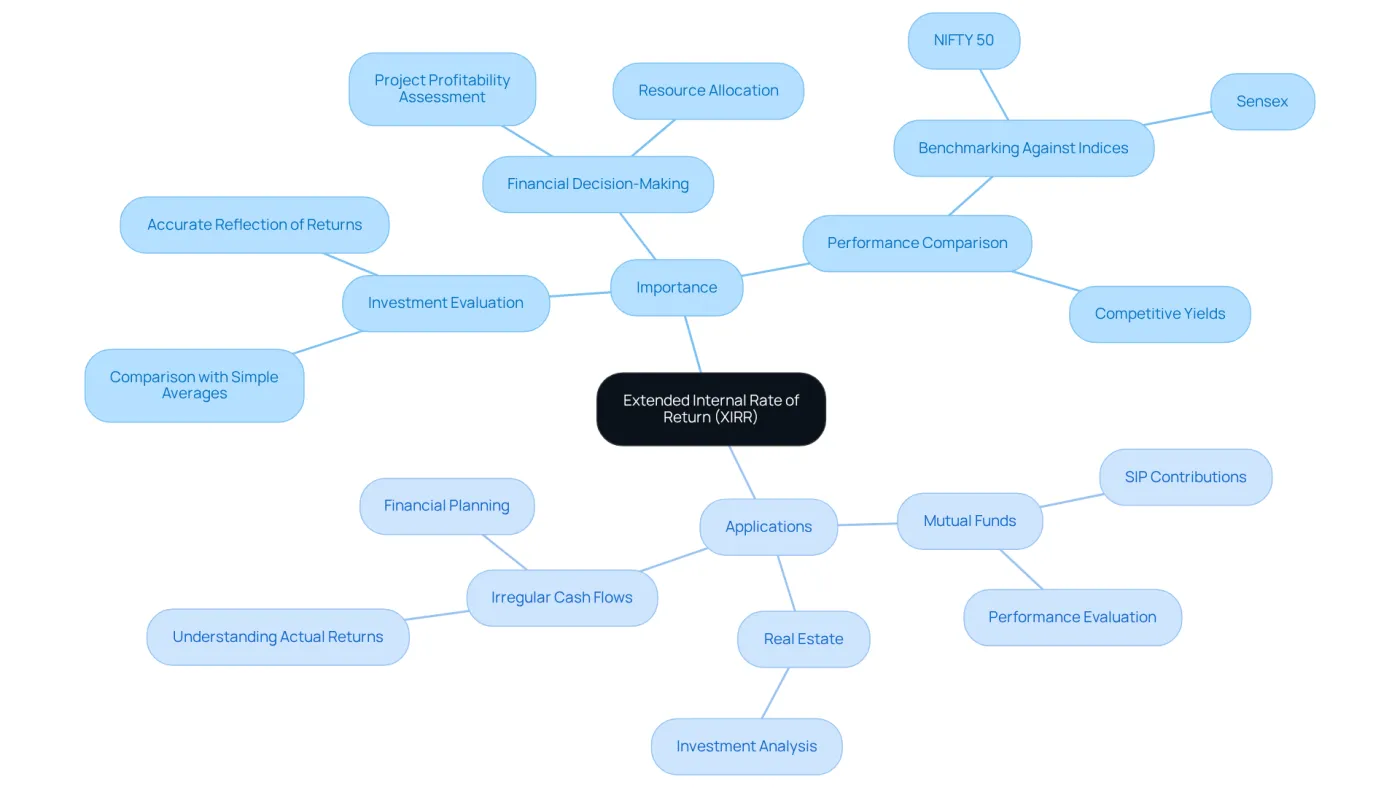
Investment Evaluation: The Extended Internal Rate of Return is vital for assessing portfolio performance, especially in collections with numerous transactions over time. It provides a more accurate reflection of returns compared to simple averages, allowing investors to evaluate the effectiveness of their strategies. For instance, a recent study revealed that eighteen equity mutual funds yielded over 15% annualized return on SIP contributions in 2025. This underscores the practical significance of annualized return in contemporary financial analysis.
Financial analysts and investors leverage the XIRR calculation formula to make informed decisions regarding resource allocation, project profitability assessment, and comparative analysis of various financial opportunities. A higher internal rate of return indicates competitive yields, validating financial strategies. As noted by Surbhi Khanna, "Investors who initiated SIPs on January 1, 2025, saw substantial returns," highlighting the importance of this metric in evaluating financial performance.
Real-World Applications: This metric is commonly utilized in mutual funds, real estate projects, and any scenario involving irregular cash flows. It empowers investors to comprehend the actual rate of return on their assets through the XIRR calculation formula, facilitating improved financial planning and informed decision-making. Moreover, assessing the internal rate of return alongside benchmark indices like NIFTY 50 or Sensex helps investors measure the performance of their mutual fund holdings against the market.
Break Down the XIRR Formula: Components and Mechanics
The XIRR formula is structured as follows:
=XIRR(values, dates, [guess])
Components of the XIRR Formula
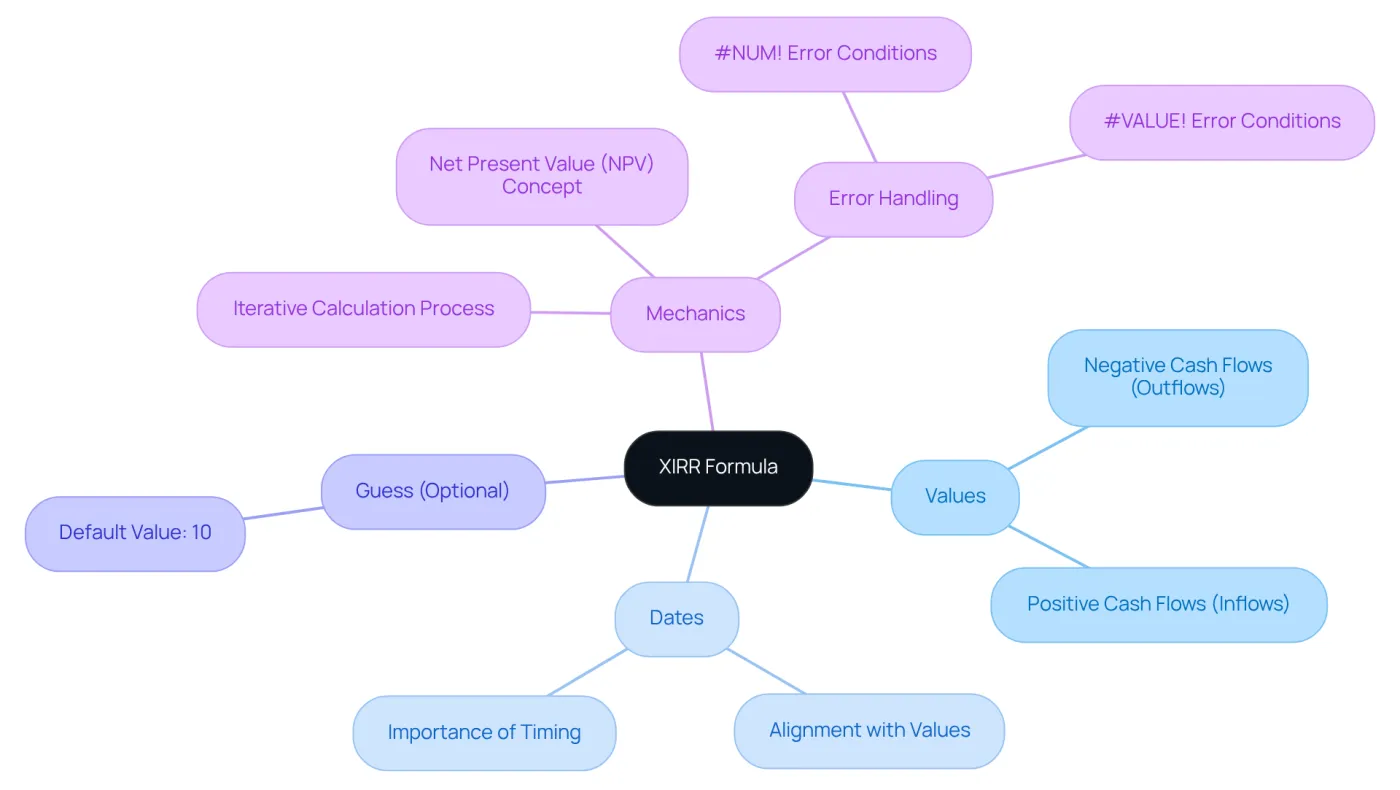
- Values: This array contains the monetary transfers related to the asset. The initial investment should be a negative value (outflow), while following monetary inflows are positive.
- Dates: This array corresponds to the dates of each monetary transaction. It is essential that the dates align with the financial values to ensure precise calculations.
- Guess (optional): This parameter provides an initial estimate of the expected return. If omitted, Google Sheets defaults to a guess of 10%.
Mechanics of XIRR
The XIRR function employs an iterative process to determine the rate of return that sets the net present value (NPV) of the cash flows to zero. Essentially, it calculates the discount rate that equates the present value of incoming funds with that of outgoing funds. This approach enables accurate modeling of assets with irregular cash flows through the XIRR calculation formula, making it an essential tool for finance professionals evaluating their portfolios.
A good annualized return for equity mutual funds is generally regarded as exceeding 12-15% over the long term, indicating effective investment performance. Additionally, a negative internal rate of return suggests losses, prompting investors to analyze their strategies and make necessary adjustments. Contrasting the internal rate of return with industry benchmarks and similar funds is also vital for evaluating relative performance.
Calculate XIRR in Google Sheets: A Step-by-Step Walkthrough
Calculating XIRR in Google Sheets is straightforward when you follow these essential steps:
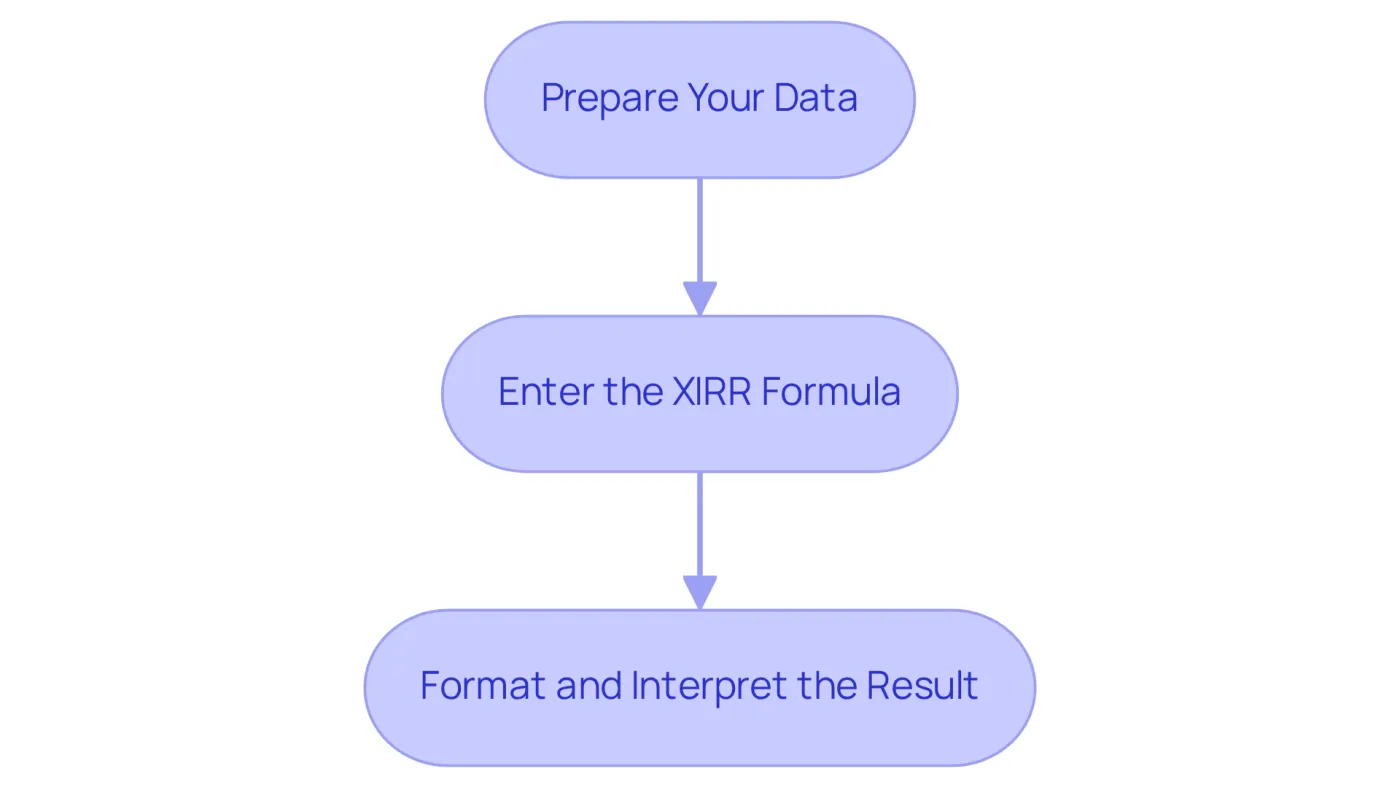
Step 1: Prepare Your Data
- Create a new Google Sheet and label two columns: 'Cash Flows' and 'Dates'.
- Enter your monetary transactions in the 'Cash Flows' column, applying the xirr calculation formula, and ensure the initial investment is negative to indicate outgoing funds.
- Enter the corresponding dates for each monetary transaction in the 'Dates' column using the xirr calculation formula. Ensure both columns are of equal length and properly formatted.
Step 2: Enter the XIRR Formula
- Click on an empty cell where you want the XIRR result to appear.
- Type the formula:
=XIRR(A2:A10, B2:B10)
Replace A2:A10 with the range of your cash flows and B2:B10 with the range of your dates.
Step 3: Format and Interpret the Result
- Press Enter to calculate the XIRR. The result will display as a decimal. To convert it to a percentage using the xirr calculation formula, format the cell accordingly.
- Interpret the result: A positive internal rate of return, derived from the xirr calculation formula, indicates a profitable investment, while a negative value suggests a loss. Ensure that your monetary movements encompass both positive and negative figures to prevent errors in computation.
Troubleshoot XIRR Calculations: Common Issues and Solutions
When using the XIRR function, users may encounter several common issues that can hinder accurate financial analysis. Here are some troubleshooting tips to help you navigate these challenges:
Common Issues
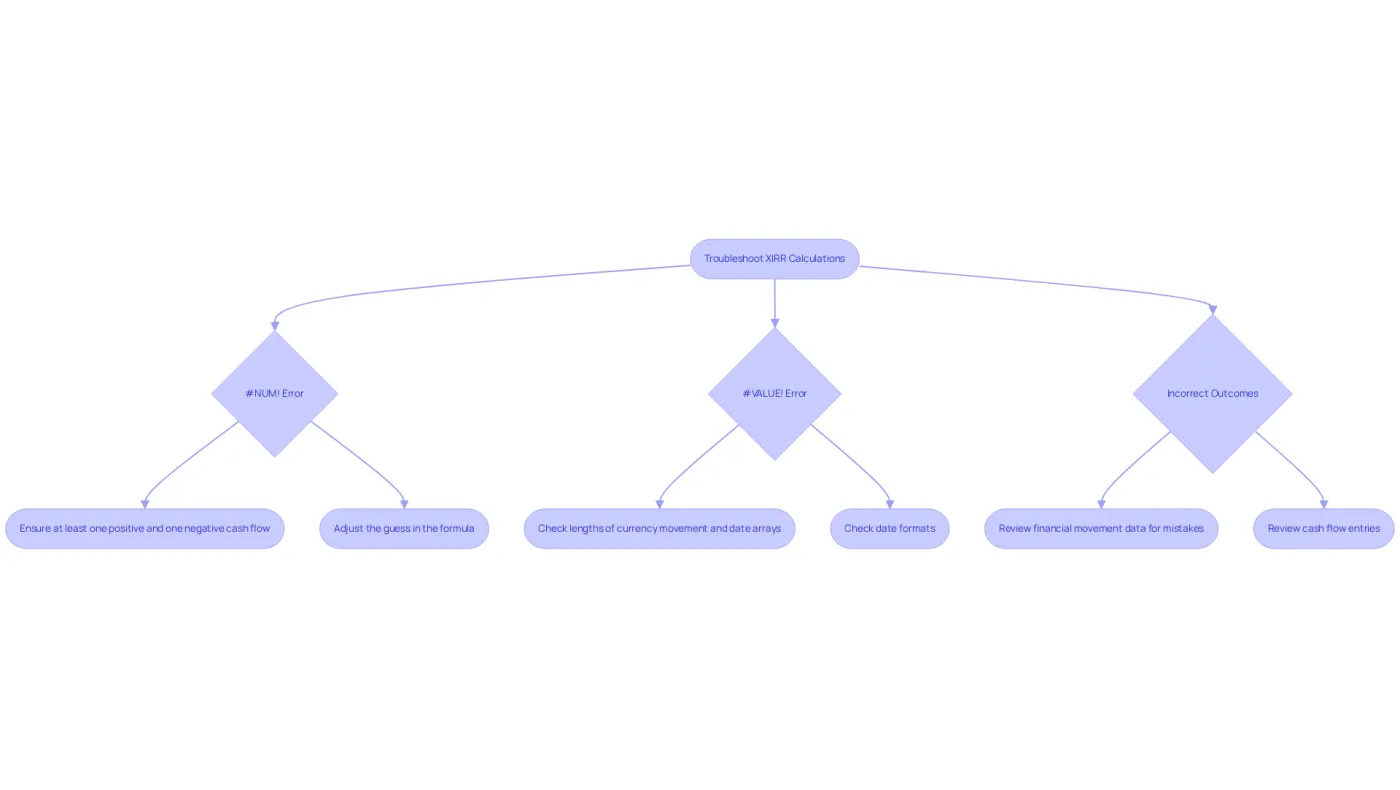
- #NUM! Error: This error arises when the function cannot find a solution after 100 iterations. To resolve this, ensure that there is at least one positive and one negative monetary movement in your data.
- #VALUE! Error: This indicates a mismatch between the lengths of the currency movement and date arrays. It's crucial to check that both arrays contain the same number of entries.
- Incorrect Outcomes: If the XIRR result seems implausible, take a moment to review your financial movement data for any mistakes. Ensure that all funds are accurately recorded and that dates are formatted correctly.
Solutions
- Adjust the Guess: If you encounter a #NUM! error, consider providing a different initial guess in the formula. For example, you might use
=XIRR(A2:A10, B2:B10, 0.1)to improve your results. - Check Date Formats: Make sure that all dates are in the correct format and that the spreadsheet locale aligns with the date format you are using.
- Review Cash Flow Entries: Double-check that all cash flows are entered correctly, ensuring that the initial investment is recorded as a negative value.
By addressing these common issues and implementing the suggested solutions, you can enhance the accuracy of your financial analyses using the XIRR function.
Conclusion
Mastering the XIRR calculation formula in Google Sheets is crucial for investors aiming to evaluate their portfolios accurately and make informed financial decisions. Understanding the Extended Internal Rate of Return allows individuals to assess their investment performance with greater precision, particularly when managing irregular cash flows. This metric not only underscores the effectiveness of various financial strategies but also equips users to navigate the complexities of investment analysis with confidence.
The article has outlined the essential components of the XIRR formula, detailing the necessary values and dates, and providing a clear step-by-step guide for calculating XIRR in Google Sheets. Common issues encountered during the calculation process have also been addressed, along with practical solutions to enhance accuracy. Such insights are invaluable for anyone looking to optimize their investment strategies and maximize their financial opportunities.
In a landscape where financial decisions can significantly impact long-term wealth, leveraging tools like the XIRR formula is vital. By applying the knowledge gained from this guide, investors can elevate their financial literacy, refine their investment evaluations, and ultimately achieve superior results. Embracing these practices not only fosters informed decision-making but also cultivates a deeper understanding of personal finance and investment management.
Frequently Asked Questions
What is XIRR?
XIRR stands for Extended Internal Rate of Return, a financial metric used to evaluate the performance of investments, especially those with multiple transactions over time.
Why is XIRR important in finance?
XIRR is important because it provides a more accurate reflection of investment returns compared to simple averages, allowing investors to assess portfolio performance and the effectiveness of their strategies.
How does XIRR assist in investment evaluation?
XIRR helps in investment evaluation by allowing financial analysts and investors to make informed decisions regarding resource allocation, project profitability, and comparative analysis of different financial opportunities.
In what scenarios is XIRR commonly used?
XIRR is commonly used in mutual funds, real estate projects, and any situations involving irregular cash flows.
How can XIRR impact financial planning?
By calculating the actual rate of return on assets, XIRR facilitates improved financial planning and informed decision-making for investors.
How does XIRR relate to benchmark indices?
Assessing the internal rate of return using XIRR alongside benchmark indices like NIFTY 50 or Sensex helps investors measure the performance of their mutual fund holdings against the broader market.