

Overview
The SUMPRODUCT function serves a crucial role in the financial sector, designed specifically to multiply corresponding elements within specified arrays and return the total of those products. This functionality makes it an indispensable tool for finance professionals, enabling them to perform complex calculations with remarkable efficiency.
In financial analysis, the applications of the SUMPRODUCT function are numerous. It is particularly effective for:
- Calculating total revenue
- Calculating weighted averages
By integrating multiple criteria without the necessity for nested functions, this function significantly simplifies data analysis.
Moreover, the SUMPRODUCT function enhances accuracy, allowing finance professionals to streamline their workflows. Its ability to handle complex calculations swiftly not only saves time but also reduces the potential for errors, thereby boosting overall productivity. Embracing this powerful tool can lead to improved financial insights and more informed decision-making.
Introduction
Understanding the intricacies of financial analysis often hinges on the ability to manipulate data efficiently. The SUMPRODUCT function emerges as a vital tool, empowering finance professionals to perform complex calculations effortlessly by multiplying corresponding elements in arrays and summing the results. However, the true power of SUMPRODUCT extends beyond its basic functionality; it has the capacity to streamline analyses involving multiple criteria. How can mastering this function transform the interpretation and utilization of financial data, ultimately leading to more informed decision-making?
Define SUMPRODUCT: Purpose and Functionality
This formula serves as a powerful asset in spreadsheet applications, such as Google Sheets and Excel, and understanding what does sumproduct do is essential, as it is designed to multiply corresponding elements in specified arrays and yield the total of those products. The primary purpose of this function is to streamline complex calculations that involve multiple criteria, which is what does sumproduct do, eliminating the need for nested functions. For finance professionals, this function proves particularly advantageous when analyzing data sets that require meeting multiple conditions, such as calculating weighted averages or aggregating sales data across various categories. By simplifying these calculations, the function significantly enhances both efficiency and accuracy in financial modeling.

Contextualize SUMPRODUCT: Applications in Financial Analysis
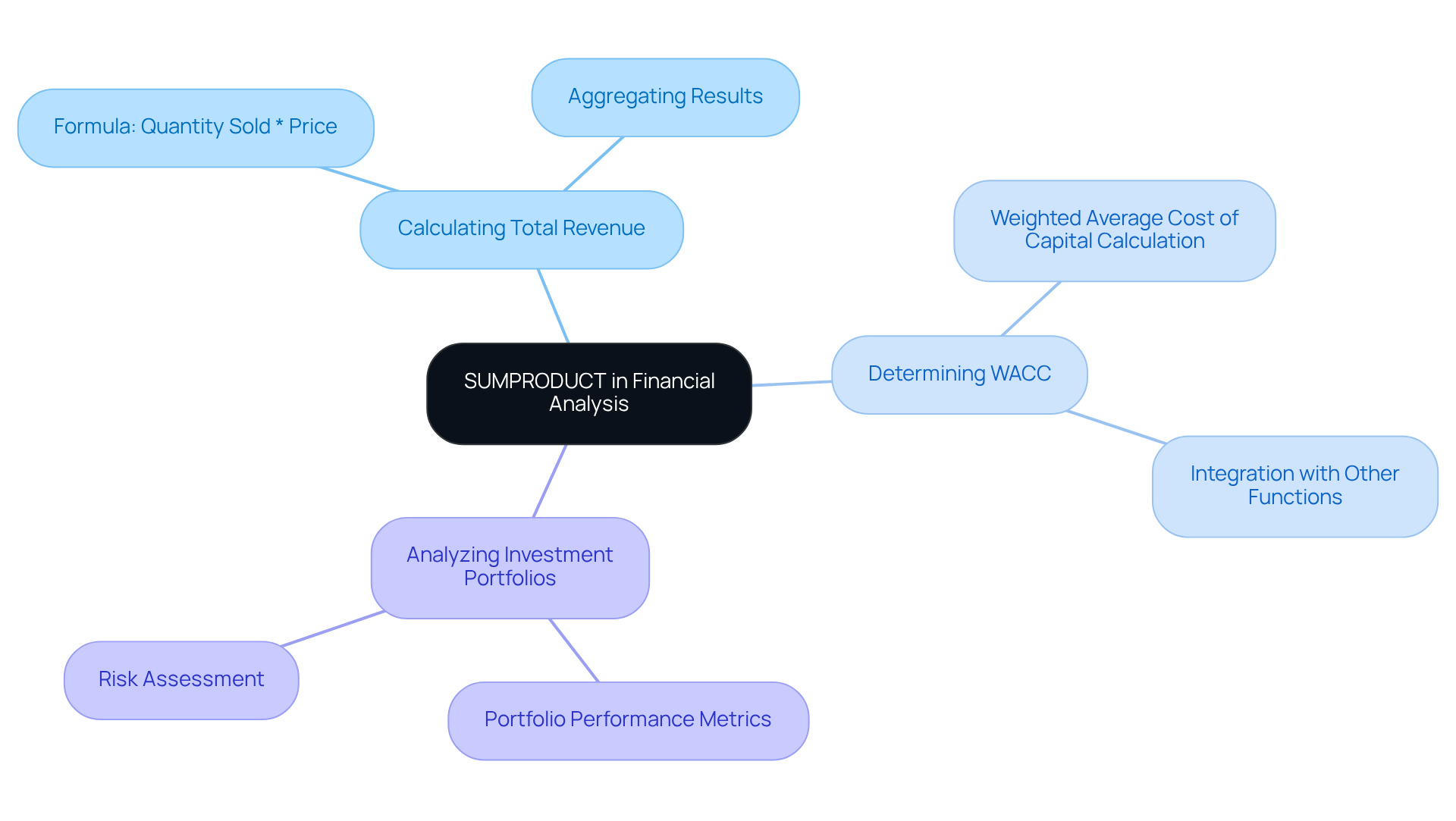
In financial analysis, knowing what does sumproduct do is essential for tasks such as calculating total revenue based on unit sales and prices, determining the weighted average cost of capital (WACC), and analyzing investment portfolios. For instance, when a finance expert aims to ascertain the overall revenue generated from various products, they can use a formula that illustrates what does sumproduct do by multiplying the quantity sold by the price for each item and aggregating the results.
This functionality streamlines the process, enabling analysts to focus on interpreting results rather than grappling with complex formulas. Furthermore, understanding what does sumproduct do allows this function to be integrated with other operations, such as IF, to create more sophisticated analyses, thereby enhancing its versatility.
By leveraging these tools, financial professionals can not only improve their analytical efficiency but also gain deeper insights into their data, ultimately driving more informed decision-making.
Understand SUMPRODUCT Syntax: Structure and Components
Understanding the syntax for SUMPRODUCT is crucial for finance professionals: SUMPRODUCT(array1, [array2], [array3], ...). The first argument, array1, is mandatory, while subsequent arrays are optional. It is essential that all arrays share the same dimensions; otherwise, an error will occur. For example, if you have two arrays representing quantities sold and prices, you would input them as follows: A2:A10 * B2:B10, where A2:A10 contains quantities and B2:B10 holds prices. Mastering this structure not only helps avoid common pitfalls but also ensures accurate calculations, reinforcing the importance of proficiency in this function.

Explore Advanced Uses: Variations and Complex Applications
Beyond basic calculations, this function serves as a powerful tool in advanced scenarios, including conditional summation and comprehensive data analysis across multiple criteria, prompting the question of what does SUMPRODUCT do. Finance professionals can utilize SUMPRODUCT in conjunction with logical operators to aggregate products only when certain conditions are met. For instance, a formula might be structured as follows:
SUMPRODUCT((A2:A10=

Conclusion
The SUMPRODUCT function emerges as an indispensable tool for finance professionals, providing a streamlined approach to complex calculations. By enabling users to multiply corresponding elements across arrays and sum the results, it simplifies tasks involving multiple criteria, such as calculating weighted averages or aggregating sales data. Mastery of SUMPRODUCT not only enhances efficiency but also guarantees greater accuracy in financial modeling.
Throughout this article, key insights have underscored the function's versatility in various financial applications. From calculating total revenue based on unit sales and prices to analyzing investment portfolios, SUMPRODUCT proves essential for financial analysis. Understanding its syntax and structure is vital to avoiding common pitfalls, ensuring that all arrays are aligned correctly for accurate results. Furthermore, advanced applications of SUMPRODUCT, such as conditional summation, further illustrate its power in complex data analysis.
Incorporating SUMPRODUCT into financial practices can lead to more informed decision-making and deeper insights into data. As finance professionals strive to enhance their analytical capabilities, embracing this function can significantly boost productivity and effectiveness. Moving forward, leveraging SUMPRODUCT not only empowers analysts but also fosters improved outcomes in financial assessments and strategies.
Frequently Asked Questions
What is the purpose of the SUMPRODUCT function?
The SUMPRODUCT function is designed to multiply corresponding elements in specified arrays and yield the total of those products, streamlining complex calculations involving multiple criteria.
How does SUMPRODUCT simplify calculations?
It eliminates the need for nested functions, making it easier to perform calculations that require meeting multiple conditions.
In what scenarios is SUMPRODUCT particularly useful?
SUMPRODUCT is particularly useful for finance professionals when analyzing data sets that require calculations like weighted averages or aggregating sales data across various categories.
What are the benefits of using SUMPRODUCT in financial modeling?
By simplifying calculations, SUMPRODUCT enhances both efficiency and accuracy in financial modeling.